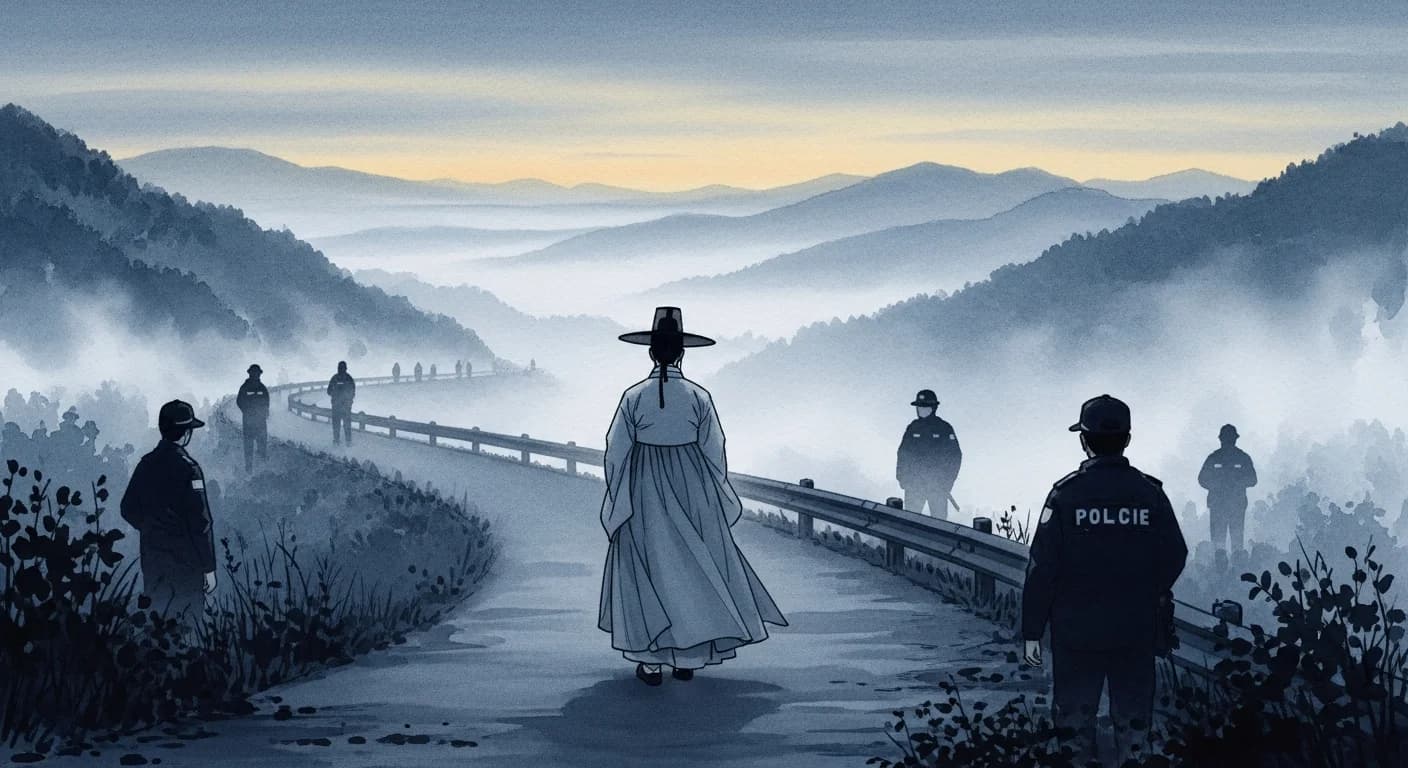
Dream of Being Arrested — What Korean Dream Tradition Really Says
If you woke up with your heart pounding from a dream where you were arrested, Korean dream interpretation (해몽) has a surprisingly nuanced answer for you — and it may not be the bad news you're expecting. In Korean tradition, the meaning of an arrest dream hinges almost entirely on who you are and what you're going through right now. For a creative person, the same dream that spells trouble for others can be a powerful omen of public recognition. There is one important twist, though — the dream's interpretation can flip completely depending on your current situation, and knowing which side you fall on makes all the difference.
Is a Dream of Being Arrested Good or Bad?
In Korean dream interpretation, no dream is permanently fixed as good or bad — context is everything, and arrest dreams are a perfect example of this principle.
For most people in most circumstances, dreaming of being arrested is a cautionary omen (흉몽). It suggests that in the near future you may face scrutiny, restrictions, or friction involving authorities, institutions, or legal matters. It warns that someone hostile to you might try to trap you in a false situation, or that you could be dragged into disputes you didn't cause. The traditional Korean term for this kind of misfortune is 관재수 (gwanjaesu) — calamity brought by public authority.
But the interpretation reverses dramatically for artists, writers, musicians, and other creative professionals. The symbolic act of being 'singled out and seized' transforms into an omen that your work will capture widespread attention and recognition. The same imagery, applied to someone already suffering from a false accusation in waking life, becomes a hopeful signal that the truth is about to emerge.
Inauspicious Meanings — Authority, Conflict, and Caution

When an arrest dream carries an inauspicious (흉몽) meaning, it tends to land in one of several areas: legal or regulatory trouble, interpersonal betrayal, or reputational risk.
The dream may be warning you to tighten up your professional conduct — especially around contracts, documentation, and compliance. If tensions with a colleague or business associate have been simmering, this dream suggests those tensions may soon surface in a more serious way. Being vigilant about keeping records of important conversations and agreements is wise after a dream like this.
Korean tradition also associates this dream with the risk of 모함 (mohm) — being deliberately set up or framed by someone with ill intentions. Acting with integrity and maintaining clear evidence of your actions serves as a practical and symbolic form of protection.
Auspicious Meanings — Recognition and the Reversal of Injustice
The auspicious (길몽) interpretations of arrest dreams showcase what makes Korean dream tradition so distinctive: its recognition that symbols carry paradoxical power.
For creative professionals, the logic is intuitive once explained: being arrested means being noticed, being singled out, being taken from the crowd. Applied to artistic work, that same energy becomes fame, recognition, and cultural impact. If you are a writer, artist, musician, or content creator, this dream may be telling you that a project is about to break through in a significant way.
For someone already living through an unjust situation — perhaps being unfairly blamed at work or entangled in a misunderstanding — the arrest dream functions as reassurance. The Korean interpretation suggests that the very injustice you are experiencing is close to resolution, and that the truth will soon do its work.
Neutral Meanings — Inner Pressure and Self-Examination
Not every arrest dream is a prediction about external events. Often, it is simply the mind's way of dramatizing what you are already feeling.
If you have been experiencing intense pressure at work, feeling trapped in a relationship, or quietly reproaching yourself over past actions, your sleeping mind may stage an arrest to put a face on that pressure. The police officer is not a real threat — it is your own sense of being constrained, judged, or out of control, given a dramatic form.
This interpretation encourages a gentle pause rather than alarm. Ask yourself: what situation in my life is making me feel like I have no freedom of movement? Where do I feel controlled, watched, or held accountable in a way that feels unfair? The dream is not a verdict — it is an invitation to look honestly at those pressures and consider whether something needs to change.
Dream Variations
Arrested by Police Dream
Being arrested specifically by police in a dream symbolizes potential friction with formal authority structures — government agencies, regulatory bodies, or institutional oversight. In a professional context, it may warn of a workplace investigation or compliance issue. Tread carefully in any dealings that involve rules, regulations, or formal procedures.
Wrongfully Arrested Dream
Dreaming that you are wrongfully arrested reflects real-life feelings of being misunderstood, unfairly blamed, or falsely accused. It can serve as a warning that someone around you may try to damage your reputation or set you up. However, for someone currently living through a real-world injustice, this dream paradoxically signals that the false accusation will soon be cleared.
Escaping from Arrest Dream
Successfully evading arrest in a dream is an auspicious sign — it suggests you will find a way through a current crisis or difficulty. Things will improve and the pressure you are under will ease. If you flee but are ultimately caught, however, it implies that the hardships you face will persist longer than you hope before resolving.
Someone Else Being Arrested Dream
When a specific person you know is arrested in your dream, it may signal developing conflict or friction in your relationship with that individual. It can also be an omen that the person will encounter restrictions or hardship in their own life. If the arrested person is a stranger, it likely reflects your heightened sensitivity to social events or news rather than a personal prediction.
Arrested as a Falsely Accused Criminal Dream
Being framed and arrested for something you did not do is a strong warning about the risk of being deliberately set up by someone with malicious intent. This dream advises keeping thorough records of your actions, conversations, and agreements — especially in financial dealings or new partnerships where trust has not yet been established.
Handcuffed and Arrested Dream
The addition of handcuffs intensifies the symbolism of constraint and lost autonomy. This dream strongly suggests that you feel your freedom of action is being severely limited — whether by a controlling relationship, an oppressive work environment, or a situation you feel you cannot exit. Recognizing what is holding you in place is the first step toward addressing it.
Arrested for a Crime You Actually Committed Dream
Dreaming that you are justly arrested for a wrong you genuinely committed points to inner guilt or regret. The dream is the subconscious mind acknowledging — and asking you to acknowledge — that something in your current behavior may be ethically problematic. Use it as a prompt for self-reflection and, if needed, course correction.
Arrested in a Foreign Country Dream
Being arrested in an unfamiliar foreign setting reflects anxiety about losing control in new or unfamiliar environments — a new job, an unfamiliar social group, or overseas business matters. It suggests that unexpected complications may arise as you navigate territory that feels outside your comfort zone.
Cultural Context
To understand why Koreans take arrest dreams so seriously, it helps to look at history. During the Joseon Dynasty (1392–1897), dreams of being summoned to a government office (관아) or seized by officers (포졸) were interpreted as omens of 관재수 (gwanjaesu) — disasters brought about by state authority. In a society where the law and administration of the ruling class profoundly shaped the lives of ordinary people, the fear encoded in such dreams was both literal and deeply cultural.
Folk practices developed in response. People who had arrest dreams might carry protective talismans called 관재부적 (gwanjae bujeok) or commission a shamanistic ritual (고사) to deflect the foretold misfortune. The boundary between dream, omen, and protective action was porous in traditional Korean life.
What makes the modern Korean interpretation of arrest dreams particularly fascinating is its duality. Contemporary dream readers preserve the traditional caution while adding an entirely new positive reading for creative people — the same dream that warns of legal trouble for one person signals public recognition for an artist or writer. This flexibility is characteristic of Korean dream tradition: the same symbol transforms based on who receives it.
Western Psychological Perspectives
Western psychological frameworks offer a compelling complement to Korean dream interpretation — and together, they illuminate different layers of the same dream experience.
Sigmund Freud would have read an arrest dream as the superego — the internalized moral conscience formed through upbringing and social conditioning — asserting control over the ego. The police officer or investigator who appears in the dream is not an external threat but a projection of your own inner judge. According to Freud, the dream is the unconscious mind's way of staging the 'punishment' of id impulses (repressed desires or forbidden urges) that the conscious mind refuses to acknowledge. The more vivid and disturbing the arrest, the stronger the underlying guilt being processed.
Carl Jung offered a different frame. For Jung, the arresting authority figure in such a dream represents the 'Law-Giver' archetype — a powerful unconscious force demanding that the dreamer confront neglected aspects of the self, what Jung called the Shadow. In the context of the Hero's Journey, arrest is not failure; it is a necessary pause, a forced descent into the underworld of the self, from which transformation becomes possible. This reading aligns remarkably well with the Korean intuition that arrest dreams carry a paradoxical positive potential.
Modern stress research and cognitive psychology offer the most pragmatic view: arrest dreams are frequently triggered by real-life situations in which the dreamer feels out of control, surveilled, or constrained — unfair treatment at work, relationship dynamics that feel suffocating, or anxiety about consequences for past decisions. When these dreams are recurrent, they are worth treating as a signal to re-examine where in your waking life you feel your autonomy is being eroded.
Across cultures and centuries, the arrest dream has returned again and again as one of the mind's primary images for the tension between freedom and constraint. Ancient Egyptian dream texts interpreted confinement by authority as divine warning. The Roman dream interpreter Artemidorus, writing in the second century CE, linked arrest imagery to fears of social disgrace. Native American traditions read dreams of bondage as a disruption of the dreamer's harmony with the natural world. The specifics differ; the human core stays the same.
Frequently Asked Questions
A dream of being arrested is rarely just a nightmare to be dismissed. Korean dream tradition — spanning centuries from Joseon Dynasty omens to modern 해몽 practice — teaches us that this dream carries layered meaning: a warning for some, an omen of recognition for others, and a mirror of inner pressure for many. Whatever its message for you, the most valuable response is the same: take an honest look at where you feel controlled, constrained, or judged in your waking life, and consider what — if anything — needs to change. Dreams speak clearly to those who take time to listen.
