Counting Numbers Dream Meaning — From Counting Money to Endless Tallying
If you dreamed of counting money and the stack kept growing thicker, Korean dream tradition has straightforward good news for you: this is one of the most recognized auspicious omens for financial fortune. In Korean folk belief, the act of counting has always been more than arithmetic — it was the measurement of one's fortune and the confirmation of ownership, which is why a successful count in a dream has long been read as a direct signal from the unconscious about real-world prosperity. But there is a meaningful flip side to this dream. When the counting never ends, or when you keep losing your place and starting over, the same symbol turns into a sharp warning about cognitive overload and burnout that deserves attention.
Auspicious — Counting Money and Precious Objects

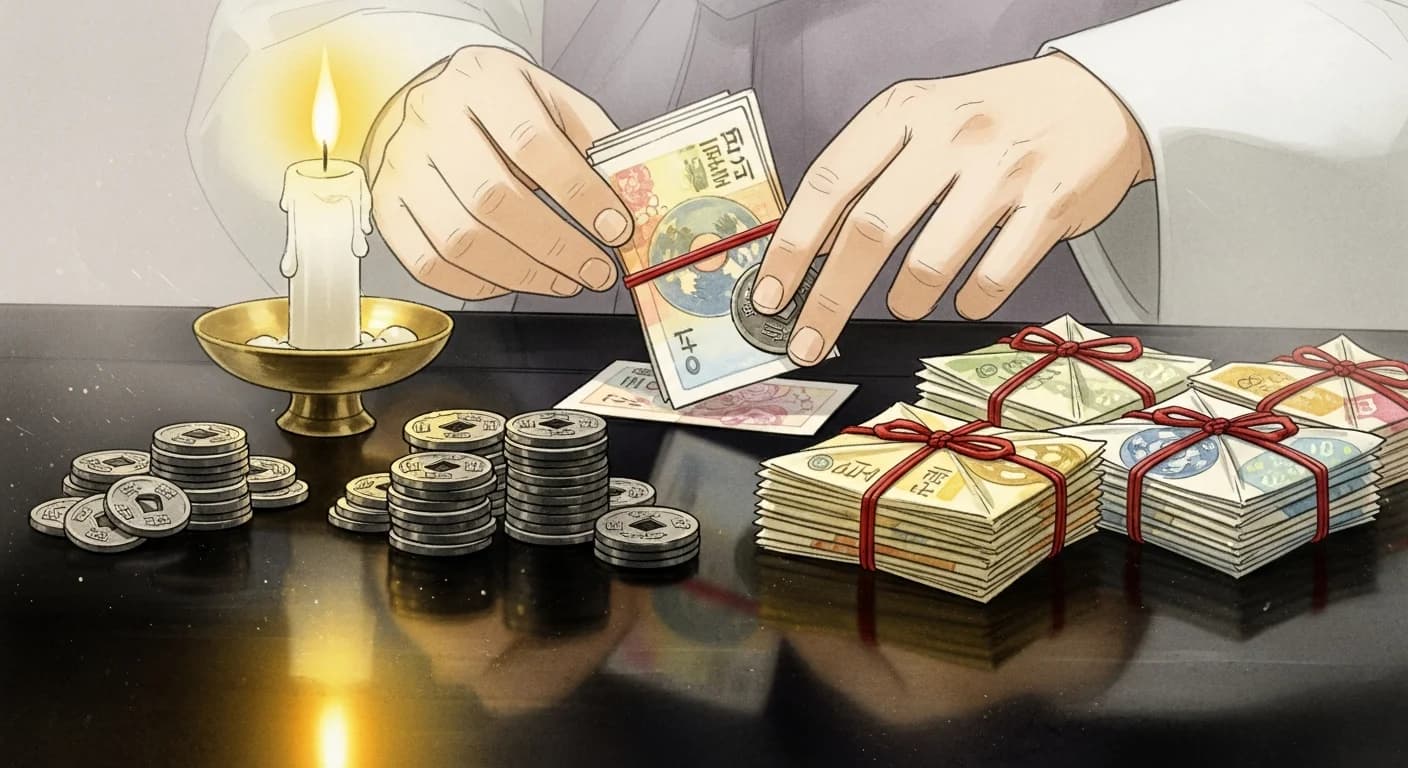
Calmly counting banknotes as the stack grows thicker in your hands, or tallying gold coins and jewels to a satisfying total, is a classic auspicious dream of financial fortune in Korean dream interpretation (해몽). The larger the pile grows during the count, the stronger the signal: unexpected income, business returns, or a long-awaited reward is drawing near. Completing the full count and arriving at a clear, accurate total is especially auspicious — it indicates that a plan you have been working on will reach a clean, satisfying conclusion without unexpected complications.
Auspicious — Counting People, Livestock, and Harvests
Dreaming of counting many people and finding there are more than you expected, or counting grain bundles after a harvest and watching the piles grow tall, is interpreted in Korean tradition as an omen of abundance and social blessings (인복). The more people in your count, the broader and more supportive your real-world social network is becoming. Counting livestock or crops signals productive outcomes and communal prosperity. Counting children in a dream is considered particularly auspicious — it specifically foretells family blessings and a healthy, flourishing household.
Inauspicious — Losing Count or Counting Endlessly
Losing track mid-count and having to restart from the beginning, or finding that the counting never reaches an end no matter how long you go, is an inauspicious dream in Korean interpretation. This dream reflects real-world cognitive overload — the sensation that something refuses to be resolved, or that responsibilities are piling up faster than they can be discharged. When the counting becomes obsessively repetitive, it is interpreted as a warning that mental exhaustion and burnout are approaching. Consider it a clear signal to reorganize priorities and allow yourself genuine rest.
Inauspicious — Numbers Don't Add Up or Counted Items Disappear
Finishing a count only to find the total is less than expected, or watching the objects disappear one by one as you try to tally them, warns of financial shortfall or a significant mistake about to surface. If things vanish while you count them, it can imply money flowing out of your life unexpectedly, or even a betrayal by someone you trusted. Counting a specific debt or loss amount in a dream is taken especially seriously — it warns that financial hardship may be becoming concrete and that close review of any pending contracts or major expenditures is warranted.
Neutral — Counting Days, Scores, and Countdowns
Counting down the days to an important event, tallying exam scores, or counting down from a large number toward zero are neutral dreams in Korean interpretation — their final meaning depends entirely on the emotional atmosphere of the dream. If the counting carries excitement and hopeful anticipation, the dream leans auspicious, signaling that an awaited opportunity is genuinely close. If it carries dread and anxiety, the dream reflects your psychological resistance to the change that is coming. Either way, the underlying message is the same: a significant transition is imminent.
Dream Variations
Counting Money Dream Meaning
Counting banknotes or coins while the pile grows thicker is a classic auspicious dream of wealth luck in Korean interpretation. It foreshadows unexpected income, business success, or a delayed reward finally arriving. The stronger and more satisfying the completion of the count, the more powerful the positive signal. However, if the money shrinks or disappears while you count, the dream flips to an inauspicious warning of financial loss.
Counting People Dream Meaning
Counting people in a dream symbolizes your social network and support system. A count that exceeds expectations is an auspicious omen — loyal collaborators and supporters are gathering around you in real life. If people disappear or the number decreases as you count, it warns of gradual estrangement or possible betrayal in your relationships.
Counting Objects Dream Meaning
Counting precious objects — gold, jewels, grain, or valuable goods — is an auspicious dream of wealth accumulation and achievement, signaling that your efforts will return as tangible results. Counting ordinary everyday possessions, however, can also reflect a real-world anxiety about losing something you value, rather than a forecast of gain.
Losing Count Dream Meaning
Losing your place and having to restart from the beginning is an inauspicious warning. It signals stalled progress, repeated mistakes, or eroding confidence in real life. This dream surfaces most often during periods of high anxiety around exams or work deadlines — a clear cue to step back, reorganize, and rest.
Counting Endlessly Dream Meaning
A dream of counting that never reaches a conclusion is a strong signal of mental overload. Unresolved problems or an overwhelming accumulation of responsibilities in real life generates this dream. If it recurs, treat it as a warning that burnout is close — rest and deliberate reprioritization are not optional at this stage.
Countdown Dream Meaning
Counting down from a large number toward zero signals that a turning point is imminent. If the countdown ends with excitement, it heralds a new beginning or opportunity arriving soon. If it ends with fear, it reflects unprocessed anxiety about an upcoming change — both variations confirm that a major shift is on the way.
Miscounting or Miscalculating Dream Meaning
Finding the total lower than expected, or being unable to reconcile the numbers no matter how many times you recount, is a warning to scrutinize important decisions before committing. It is an especially timely omen if you are about to sign a contract, make an investment, or undertake a major financial decision.
Counting Grains or Beans Dream Meaning
Counting rice kernels or beans one by one is an auspicious dream rooted in Korean agrarian tradition. Grain was historically the symbol of life and prosperity, and carefully tallying it grain by grain signals that patient, conscientious effort will accumulate into real abundance — a dream built on the folk wisdom that even a single grain of rice holds great value.
Counting Stars Dream Meaning
Counting stars in the night sky is a romantic, neutral dream of enumerating one's wishes and aspirations. Successfully counting all the stars is auspicious — it signals that vague wishes are crystallizing into achievable goals. Too many to count suggests your objectives are still too diffuse to pursue effectively. This dream also echoes the Korean shamanic tradition of counting the seven stars of the Big Dipper while making a wish.
Counting Prayer Beads Dream Meaning
Counting Buddhist prayer beads (염주) or a rosary is a neutral dream of concentration, spiritual practice, and inner purification. Completing the full count is auspicious — it signals that an ongoing effort or practice will reach completion and bring inner peace. For non-practitioners, it indicates that the current moment requires focus and patience.
Cultural Context
In Korean folk tradition, counting extended far beyond mere quantification — it was the confirmation of ownership and the measurement of one's fortune (복). The merchant counting coins at market, the farmer tallying grain bundles after harvest, and the fortune-teller calculating a person's four pillars (사주) to read their destiny all share a deep cultural reverence for counting as a foundational life act. In shamanic ritual (무속), the precise counting of offerings and the exact number of ritual recitations were believed to determine the spiritual efficacy of the ceremony. Buddhist practice reinforces this: performing exactly 108 prostrations — not 107, not 109 — is required to extinguish the 108 afflictions of the mind, giving counting an explicitly sacred dimension. Ancestral rites (제사) likewise required rule-bound counts for bows and offered cups as the mark of ceremonial completion. This tradition rests on the folk conviction that accurate counting invites fortune while error invites misfortune — making the outcome of counting in a dream a direct mirror of one's real-world fortunes.
Western Psychological Perspectives
From Freud's perspective, counting in dreams connects to an obsessive need for order and control. He observed that patients with obsessional neurosis exhibited ritualistic counting behaviors — tallying objects or repeating actions a precise number of times — as a defense mechanism against underlying anxiety. Repetitive counting in dreams is therefore read as the sleep-state expression of suppressed anxiety and control impulses that the waking mind keeps in check. Counting money in particular can be interpreted as a symbolic manifestation of repressed desires around wealth and material security, which Freud associated with the anal stage of psychosexual development.
Jung's framework offers a different and complementary reading. In his view, counting in a dream symbolizes the conscious mind's attempt to identify and integrate the contents of the unconscious one by one. The act of enumeration closely parallels the individuation process — the self recognizing and accepting its inner components in an ordered sequence. A dream in which counting reaches a complete, satisfying total signals approaching psychological wholeness. A count that proves endless or numerically overwhelming suggests that a vast body of unconscious material remains unacknowledged, waiting to be integrated.
Modern cognitive psychology frames counting dreams as a continuation of the brain's daytime information processing during sleep. Research indicates that people under strong cognitive pressure related to financial management, academic achievement, or complex decision-making dream of counting more frequently than average. The pattern of failed or endless counting in dreams also shows a statistically notable correlation with generalized anxiety disorder (GAD) and burnout symptoms — suggesting that tracking the emotional quality of counting dreams in a journal could serve as a useful early-warning system for stress levels.
Across cultures, counting carries strikingly consistent symbolic weight. Western popular culture associates counting sheep with sleep induction — using monotonous repetition to deliberately release consciousness. Islamic devotional practice with the subha (tasbih) bead counter, Catholic rosary prayer, and Korean Buddhist 108-bead chanting all use repetitive counting as a meditative or devotional act. Whether the context is spiritual, psychological, or folkloric, counting emerges as a cross-cultural symbol of concentration, dedication, and the human drive to establish inner order.
Frequently Asked Questions
Counting dreams in Korean interpretation hinge almost entirely on the outcome: a count that grows and completes is one of the most direct omens of incoming wealth and social abundance, while a count that stalls, repeats, or never ends is an equally direct signal of overload and impending burnout. The variety of what you count — money, people, grain, stars — each adds its own specific meaning. Pay attention not just to what you counted in the dream, but to how the counting felt, and whether you reached a satisfying end. That emotional texture is the most reliable guide to what the dream is telling you.