Sleeping Dream Meaning — When Korean Tradition Says Rest Is a Sign
If you dreamed of sinking into a deep, undisturbed sleep, Korean dream tradition has something reassuring to tell you — that quiet slumber signals harmony of body and mind, and often foretells health, good fortune, and the resolution of long-standing troubles. For centuries, Korean folk interpretation has treated the quality of sleep within a dream as a mirror of one's real-life balance, with restful sleep read as a blessing and troubled, elusive sleep as a warning. But here's the nuance that makes this dream genuinely interesting — the setting and circumstances of that dream sleep completely flip the reading. Whether you drifted off in peaceful solitude or found yourself nodding off at an exam desk matters enormously, and the difference is sharper than you might expect.
Deep, Peaceful Sleep — An Auspicious Omen of Health and Stability

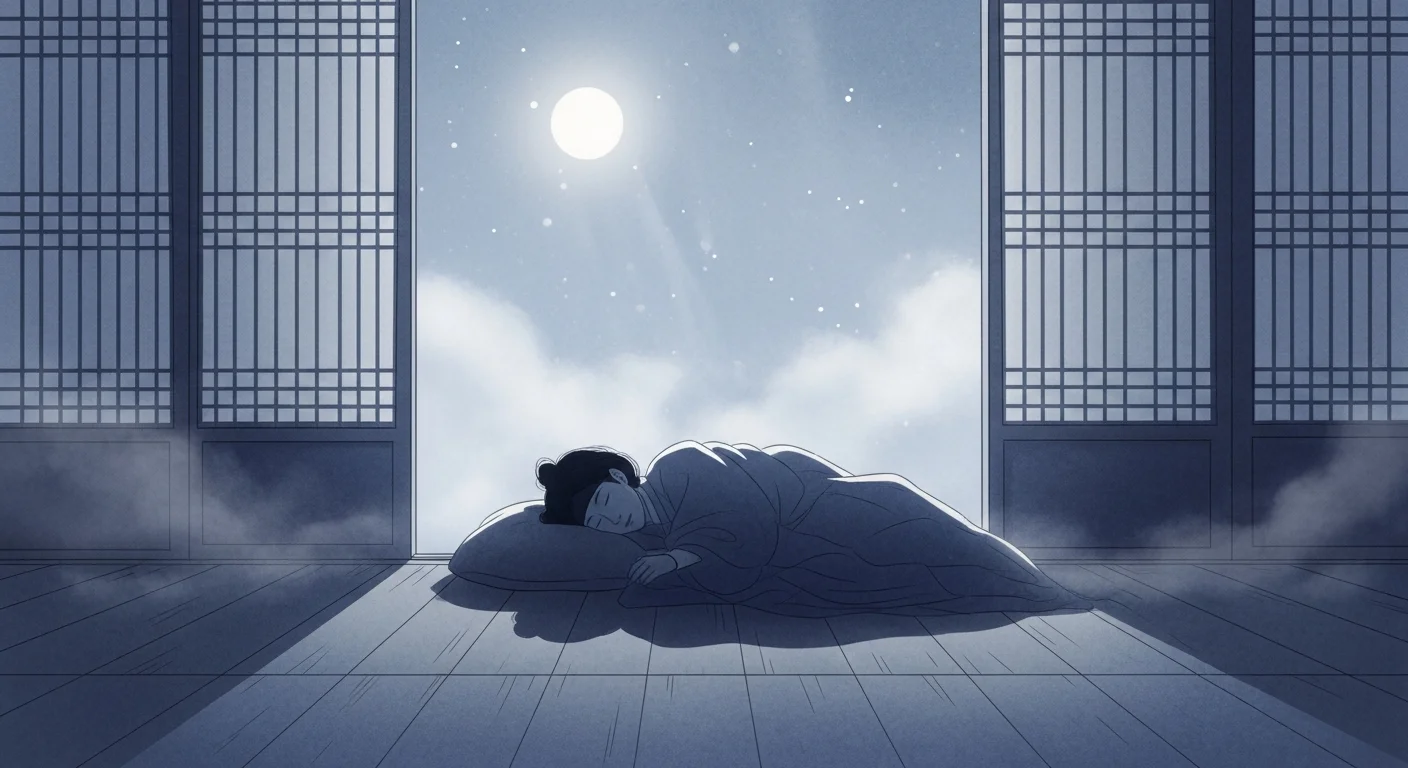
In Korean folk dream interpretation (해몽), falling into a deep, peaceful slumber within a dream is one of the clearer good omens. Traditional wisdom holds that dreaming of sleeping soundly foretells recovery of health, accumulation of wealth, or the smooth resolution of a long-awaited problem. If the sleep felt genuinely restful and worry-free, it is understood as a sign that current hardships will ease and a stable, fortunate period is drawing near. For those who have been dealing with illness, it is often interpreted as a signal of recovery; for those facing financial difficulty, it suggests the tide is about to turn.
Sleeping Together with Family — Harmony and Household Fortune
Dreaming of family members sleeping peacefully together — side by side, in quiet domestic harmony — is considered an auspicious dream. In Korean tradition, the image of a family at rest in tranquility carries the symbolic promise that good fortune will bless the household and that family bonds will deepen. Dreaming of parents sleeping comfortably is particularly significant: it is traditionally read as a foretelling of the parents' longevity and the prosperity of their descendants. If the whole family was gathered in peaceful sleep, consider it a warm and hopeful sign.
Unable to Sleep or Searching for a Place to Sleep — A Warning of Confusion and Conflict
Dreaming of being unable to fall asleep — or wandering desperately in search of somewhere to rest — is interpreted as an inauspicious dream in Korean tradition. This type of dream reflects unresolved real-life conflicts, a sense of losing one's bearings, or indecisiveness in the face of important decisions. It is read as a warning that instability in relationships or goals may be building below the surface. When this dream recurs, Korean interpretive tradition takes it seriously as a signal of deepening psychological exhaustion — the unconscious mind's way of asking you to stop, reflect, and address what you've been avoiding.
Falling Asleep at an Exam, Workplace, or Interview — Fear of Failure and Lost Trust
Falling asleep in an important setting — during an exam, at a job interview, or in the middle of work — is among the more clearly inauspicious sleep dreams. Korean tradition reads this as a warning connected to the fear of not fulfilling responsibilities, social failure, or the risk of missing a critical opportunity. The specific cultural logic is that sleeping in an inappropriate or high-stakes place signals that mistakes, failures, or a loss of others' trust may occur. If you had this dream before a big event, treat it as a prompt to review your preparation — not as doom, but as a nudge.
Sleeping in an Unfamiliar Place — Change and New Beginnings
Dreaming of sleeping somewhere unfamiliar — a strange room, a journey, a place you do not recognize — tends to carry a neutral interpretation in Korean tradition. It can represent adaptability to new environments, a desire to step away from daily routine, or a psychological readiness for change that lies ahead. The mood of the dream is the deciding factor: if the unfamiliar place felt peaceful, the dream leans auspicious — a change for the better may be coming. If the unfamiliar setting felt unsettling or anxious, the dream reflects real-life apprehension about upcoming transitions.
Pretending to Sleep — Emotional Avoidance and Suppressed Communication
Dreaming that you are pretending to be asleep — lying still with eyes closed while mentally awake — is a psychologically telling image. Korean interpretation reads it as a signal that you are avoiding a situation or person in waking life that you are not ready to confront. It reflects a pattern of suppressing honest emotion rather than expressing it, and suggests that direct, sincere communication is overdue in some relationship or situation. This dream is not typically categorized as strongly auspicious or inauspicious — it is a mirror held up to your own avoidance.
Dream Variations
Dream of Falling into Deep Sleep
A dream of sinking into deep, peaceful slumber is an auspicious omen signaling stability of mind and body. It foretells the easing of long-standing worries and improvement in health and financial matters. A reassuring dream when you've been going through a difficult stretch.
Dream of Sleeping with Family
Sleeping side by side with family in a dream is an auspicious sign of domestic harmony and household peace, suggesting that family bonds will grow stronger. Seeing parents sleeping comfortably is particularly associated with their longevity and the prosperity of their descendants.
Dream of Sleeping Next to a Stranger
Sleeping beside someone you do not recognize in a dream may signal the arrival of a new relationship or new professional opportunity. It can also represent a process of self-exploration — discovering unfamiliar aspects of your own identity. The dream's mood determines whether this is encouraging or unsettling.
Dream of Sleeping During an Exam
Falling asleep during an exam is one of the most recognizable inauspicious sleep dreams. It reflects academic or professional anxiety and fear of failure — specifically, the worry that you are not adequately prepared or might miss a critical opportunity. A prompt to review your readiness.
Dream of Sleeping at Work
Dreaming of falling asleep at work suggests dissatisfaction with your current role or anxiety about a stagnating career path. Korean tradition reads it as a signal that reassessment of your professional direction may be needed. This dream often arises during periods of burnout.
Dream of Sleeping with a Romantic Partner
Sleeping peacefully alongside a partner in a dream reflects deep trust and emotional intimacy — a sign that the relationship is grounded and secure. It is often viewed as an auspicious dream suggesting the connection between you will deepen further.
Dream of Sleeping in an Unfamiliar Place
Resting in an unknown location within a dream points to your adaptability and openness to new environments, or a desire for a fresh start. Whether auspicious or not hinges on how the setting felt: peaceful suggests a positive change ahead; anxious reflects worry about real-life transitions.
Dream of Being Unable to Sleep
Being unable to fall asleep in a dream — despite desperate attempts — is an inauspicious sign of extreme stress, unresolved conflict, or inability to make a crucial decision. Korean tradition reads it as a call to find inner peace and directly confront whatever has been weighing on you.
Dream of Pretending to Sleep
The peculiar image of pretending to sleep — being internally awake while lying still — signals emotional avoidance in real life. You may be sidestepping a person or situation that feels uncomfortable to face. The dream is a gentle but clear nudge toward honest communication.
Dream of a Baby Sleeping
A peacefully sleeping baby in a dream is an auspicious symbol of purity and new beginnings. It may suggest that new possibilities are opening up, or that a long-standing problem is finally approaching a clean resolution.
Dream of Sleeping in a Car
Sleeping inside a car in a dream suggests a need to pause and recharge during a busy period of life's journey. It reflects psychological readiness for change or transition that is approaching. A good dream to have before a major life decision — it says rest before you move forward.
Dream of Not Finding a Place to Sleep
Wandering in search of somewhere to sleep, but being unable to find any rest, is an inauspicious dream reflecting confusion about life's direction or a loss of purpose. Korean tradition reads it as a sign that reorientation — of goals, values, or relationships — is needed.
Cultural Context
In traditional Korean dream interpretation, dreaming about sleeping carries complex messages that go far beyond simple rest — communicating the state of one's life and omens for the future. From the Three Kingdoms period onward, dreams were regarded as messages from spirits or ancestors, and the state of sleep was seen as a special threshold where the boundary between the real world and the spiritual realm grows thin. During the Joseon Dynasty, kings recorded and interpreted their dreams, even incorporating their meanings into royal policy decisions — underscoring the deep cultural authority of dream interpretation in Korean history. Dreams of sleeping are sometimes read through the principle of 'yeok-mong' (역몽), or 'reverse dream': an apparently negative image — such as lying ill in bed — is actually read as a foretelling of high achievement or an unexpected promotion. Restful sleep was itself a symbol of good fortune (복, 福), and sleeping well was taken as tangible evidence of health and abundance in one's life. Traditional interpreters such as mudang (shamans) and Buddhist monks analyzed sleep-related dreams by considering the sleeping environment, the people present, and the location — not just the act of sleeping itself.
Western Psychological Perspectives
Three major Western frameworks — Freudian psychoanalysis, Jungian analytical psychology, and modern cognitive research — each approach dreams about sleeping from a distinct angle. Interestingly, all three converge on a point that Korean folk wisdom has long taken as given: the quality of sleep within a dream reflects the quality of the dreamer's inner life.
Freud called the dream itself the 'guardian of sleep' — its purpose was to protect rest by processing disruptive mental material. Within that framework, dreaming of falling asleep can be read as the unconscious expressing a wish to escape real-world tension or conflict. Falling asleep in high-stakes settings (exams, the workplace) takes on particular significance in Freudian terms: it may symbolize repressed fear of failure, or a hidden resistance to the authority structures those settings represent. Freud would see the desire to sleep within a dream as an unconscious cry to be released from waking-life pressure.
Jung offered a fundamentally different reading. For him, the act of sleeping within a dream symbolizes the ego surrendering its conscious control and allowing the flow of the collective unconscious to emerge. Unlike Freud, Jung viewed dreams not as disguised wishes but as the unconscious mind's honest self-portrait. In sleep-related dreams, the location, the people present, and the quality of rest become symbols illuminating the dreamer's inner psychological state — and sometimes the 'shadow,' the parts of oneself the conscious mind refuses to acknowledge.
Modern psychology is more pragmatic. Recurring dreams of sleeplessness or inappropriate sleep are now understood as potential early signals of burnout, psychological exhaustion, or chronic stress. Conversely, vivid dreams of deep, peaceful sleep correlate with psychological resilience and a felt sense of safety. Researchers have also highlighted that the emotional residue upon waking — how you feel after the dream ends — is often a more accurate indicator of your actual psychological state than the dream's content itself.
Across cultures, sleep-related dreams carry universal resonance as symbols of the desire for inner rest and escape from daily demands. Ancient Greek and Egyptian traditions regarded sleep as a sacred state of divine communication — a view that parallels the Korean shamanic understanding of sleep as the time when spirit messages arrive. Chinese classical tradition sometimes interpreted sleeping within a dream as a sign of declining yang energy (陽氣), or weakening vitality, offering an instructive contrast to Korea's reverse-dream (역몽) tradition, in which apparent weakness is often read as a precursor to unexpected strength.
Frequently Asked Questions
Dreams about sleeping are deceptively simple in appearance but rich in meaning once you look at the context. Peaceful, deep sleep points toward approaching stability, good health, and fortune resolving in your favor. Restless, elusive sleep — or sleep in the wrong place at the wrong time — asks you to look honestly at whatever you have been avoiding or postponing in waking life. Korean dream tradition has tracked these patterns for centuries, and what emerges is a consistent insight: the way you sleep in a dream mirrors how settled or unsettled your inner life truly is. Whatever your dream brought, treat it as useful information — and rest well.