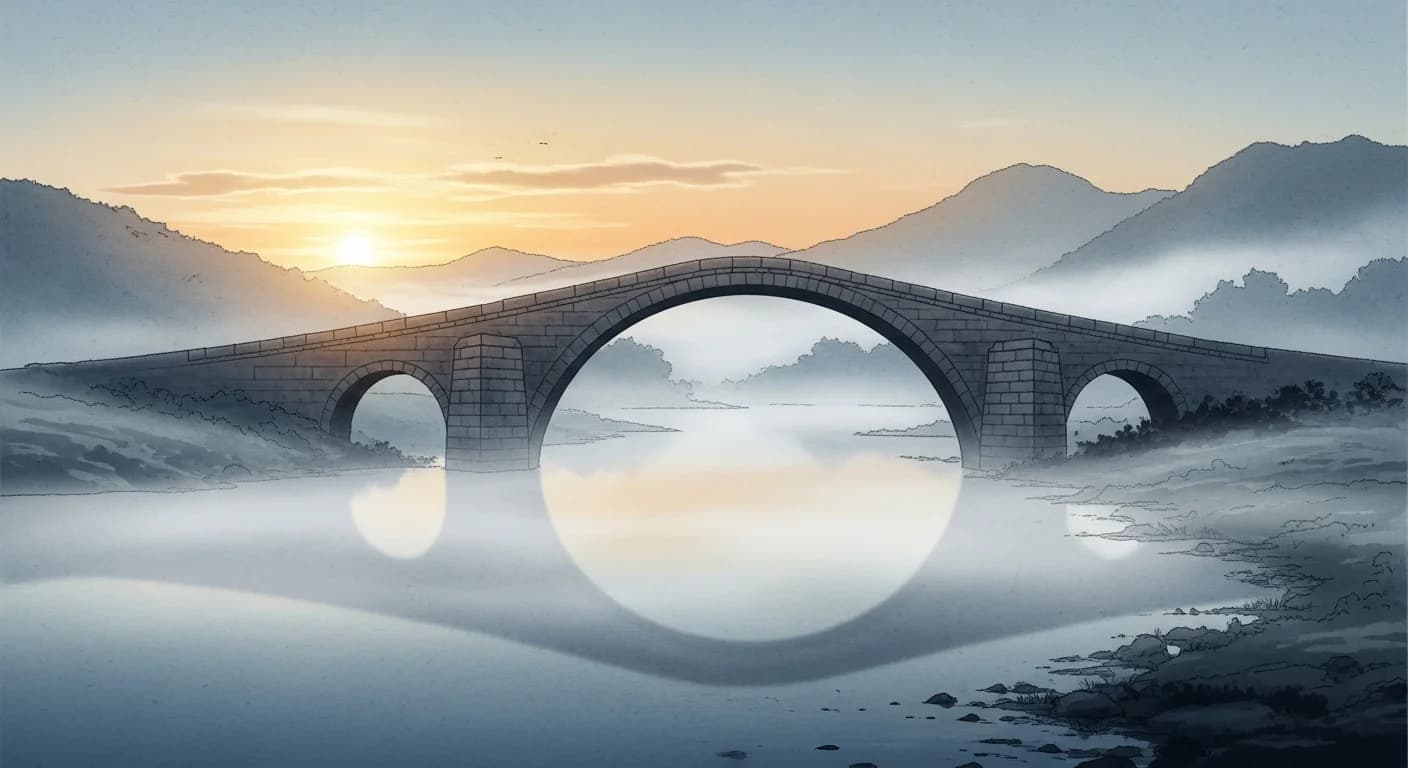
Bridge Dream Meaning — Transitions, Crossroads, and What Lies Ahead
If you crossed a bridge with confident, easy strides in your dream last night, Korean dream tradition reads that as a strong signal: the challenge in front of you is about to yield results. The bridge has always held a special place in Korean dream interpretation — not just as a path from A to B, but as a sacred threshold between states of being, between the world you know and the world you are stepping toward. Here's the thing though — whether the dream turns out auspicious or ominous depends entirely on how you crossed (or didn't cross) that bridge, and the condition it was in.
Crossing a Bridge — The Classic Auspicious Dream
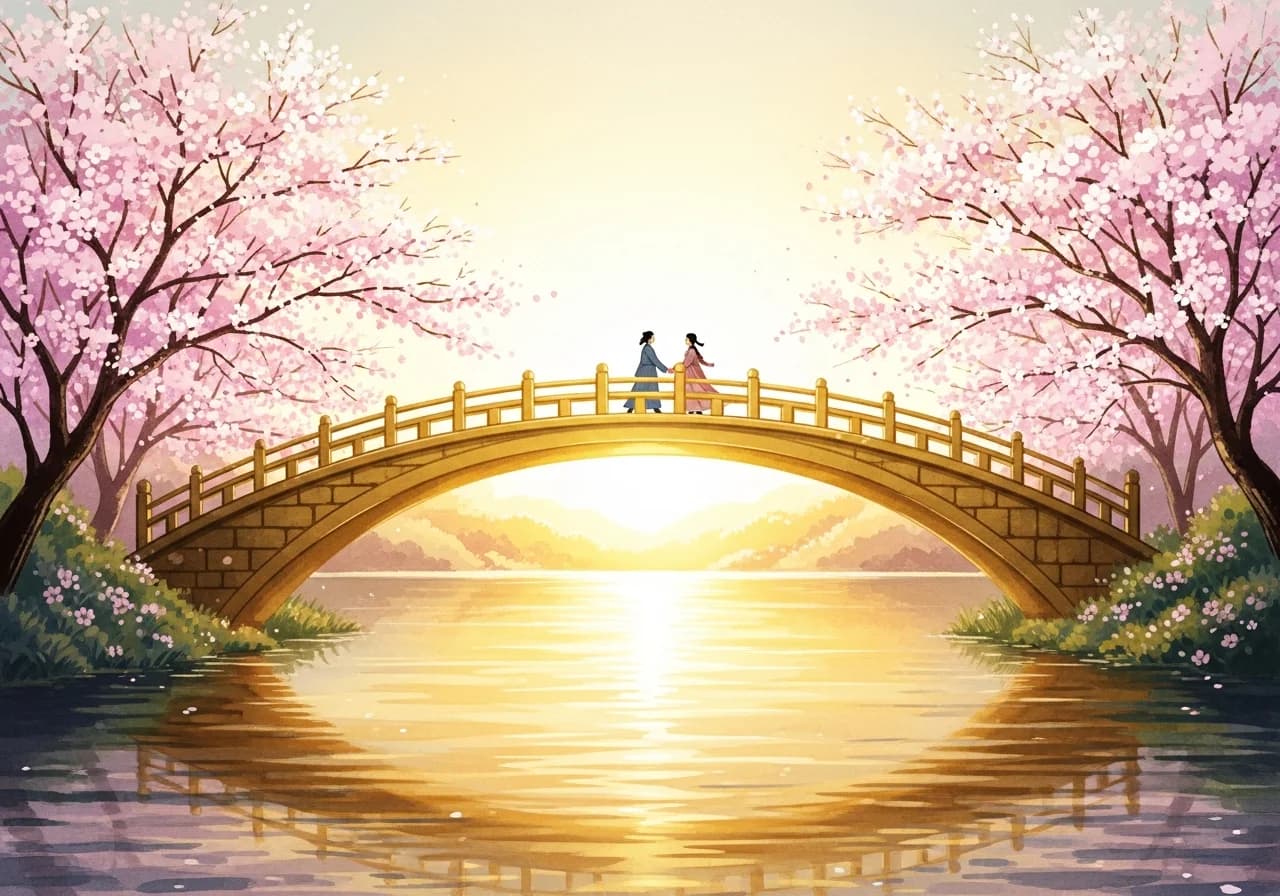
Walking across a bridge confidently and reaching the far side is one of the most consistently auspicious dream signs in Korean tradition (길몽, gilmong — a dream of good fortune). For job seekers, it hints at acceptance news on the horizon; for people in business, it signals a contract or investment success drawing near. If your steps felt light and the crossing felt natural, the omen is even stronger.
A wide, new, or golden bridge appearing in the dream amplifies the positive reading — expect a rise in status, help from a benefactor, or an unexpected windfall. Crossing alongside someone you know in waking life is an auspicious sign that your bond or collaboration with that person will deepen and bear fruit.
A Bridge Collapsing or Falling — Warning of Disruption
A bridge suddenly collapsing, or falling from a bridge into the water below, is classified as 흉몽 (hyungmong — an inauspicious warning dream). It cautions that a carefully laid plan may hit an unexpected obstacle, or that a financial loss, reputational setback, or sudden rupture in an important relationship could be ahead. If this dream arrives before a major decision or contract, it is worth pausing for a careful second look at the details.
One important nuance: if the dream continues beyond the collapse — a new bridge appears, or you discover another path — that trajectory reverses the reading into a positive one. Overcoming the crisis leads to something better. Similarly, if you fall into the water but swim to safety on your own strength, the dream signals resilience and the ability to emerge from any setback intact.
Frozen on the Bridge — Standing at a Crossroads
Standing motionless on a bridge, unable to move in either direction, is neither auspicious nor inauspicious in itself — it is a mirror of indecision. This dream pattern appears most often when the dreamer faces a significant life choice: a career shift, a relationship decision, a move, a major commitment not yet made. The subconscious is surfacing what the waking mind has been circling without resolution.
Standing on a bridge and looking down at the water flowing beneath is a slightly different signal — it suggests the dreamer is gaining distance and perspective on the situation. The unconscious advice is to use that reflective moment well: slow down, observe without pressure, and let the decision form from a place of clarity rather than urgency.
Bridge Over Water and Wealth Luck
Crossing a bridge over a river, sea, or deep gorge represents the courage to advance toward a goal in the face of uncertainty. The condition of the water below matters enormously: calm, clear water promises smooth progress and improved financial or professional luck. Turbulent or murky water below the bridge, however, warns that the path ahead will carry significant difficulty — not a reason to turn back, but a prompt for more thorough preparation before committing.
Dream Variations
Crossing a Bridge Dream
Safely crossing a bridge is an auspicious dream of overcoming a current barrier — in job seeking, exams, negotiations, or relationships. If the crossing felt easy and refreshing, the positive omen is especially strong.
Bridge Collapsing Dream
A collapsing bridge warns that plans may not proceed as intended or an unexpected crisis could emerge. Review important decisions or contracts carefully. If a new bridge or alternate path appears afterward, the dream reverses into a positive sign of overcoming and rebuilding.
Bridge Over Water Dream
Crossing a bridge over water represents courage amid uncertainty. Calm water below means smooth sailing ahead; turbulent or murky water signals that the path will involve substantial difficulty and demands careful preparation.
Old Wooden Bridge Dream
An old, creaking wooden bridge warns that your current foundation may be fragile or that risks are being underestimated. If you successfully cross despite its instability, the dream praises your careful navigation under difficult conditions.
Suspension Bridge Dream
A swaying suspension bridge or rope bridge symbolizes maintaining balance and forward motion through an unstable life transition. Persisting through the swaying to reach the other side is an auspicious sign; turning back mid-crossing reflects fear and lack of confidence in a pending decision.
Standing on a Bridge Dream
Frozen on a bridge without moving reflects indecision at a life crossroads. Looking down at the flowing water suggests a healthy objectivity toward your situation — a signal to take the reflective time the dream is offering before committing to a direction.
Bridge to Nowhere / Endless Bridge Dream
Walking endlessly on a bridge that never ends reflects exhaustion and a sense that goals feel unreachable despite sustained effort. The dream counsels pausing, reassessing your targets, and building a more step-by-step, realistic plan.
Jumping Off a Bridge Dream
Jumping freely and joyfully from a bridge into the water is an auspicious sign of bold decision-making and the courage to embrace a new challenge. Falling in fear or despair signals overwhelming stress and a need for emotional support in waking life.
Magpie Bridge (Ojakgyo) Dream
Dreaming of the Ojakgyo — the legendary bridge formed by magpies on Korea's Chilseok night — foretells a reunion with someone long absent or the fulfillment of long-awaited love. Crossing it with a partner symbolizes love's victory and reunion after separation.
Bridge to the Afterlife Dream
A bridge leading to the afterlife or an unknown realm signals a major life transformation ahead, or may foreshadow the loss or departure of someone close. In shamanic interpretation, approaching this bridge but turning back is actually hopeful: you are escaping a mortal crisis and returning to health and vitality.
Cultural Context
In Korean traditional culture, a bridge (교, 橋) was never merely a practical structure — it was a sacred threshold connecting this world to the next. In Korean shamanism (무속, Musok), the soul's journey to the afterlife was called 'jeoseuonggil' (저승길), and it was believed to include a bridge that the departed soul must cross. During shamanic rites such as 'Darigeut' (다리굿, bridge ritual), the shaman performed ceremonies specifically petitioning for the safe crossing of the deceased's spirit.
The most culturally beloved bridge in Korean tradition is the Ojakgyo (오작교, Magpie Bridge) from the Chilseok legend. Gyeonu (the Cowherd star, Altair) and Jiknyeo (the Weaver star, Vega), separated by the Milky Way, are permitted to meet just once a year on a bridge formed by magpies and crows stretching their bodies across the galaxy. This image — separation longed for, reunion finally arrived — has become one of Korea's most enduring metaphors for love that is difficult but destined.
Korea's modern history adds yet another layer. During the Korean War, the Han River bridges were blown up to slow the advancing North Korean forces while thousands of civilian refugees were still crossing — a wound in the national consciousness that fused the bridge with the ideas of survival and sacrifice simultaneously. Those same bridges later became symbols of Korea's postwar reconstruction and economic rise, giving the bridge the additional meaning of a crossing from poverty to prosperity.
From a pungsu-jiri (풍수지리, Korean feng shui) perspective, bridges channel vital energy (기맥, gi energy) between mountains and water. Communities believed a single stone bridge could affect the fortune of an entire region, and constructing a new bridge always required a shamanistic ritual (고사) to honor the local spirits and secure the bridge's blessing.
Western Psychological Perspectives
Western psychology offers a rich parallel framework for understanding bridge dreams. From a Freudian standpoint, a bridge represents a transition between psychological states — often linked to the release of repressed desires or the approach of something socially forbidden. Looking down from a bridge at the water below can express simultaneous longing to descend into the deeper unconscious and fear of what might be found there. Crossing successfully signals a repressed impulse rising to conscious expression; a broken bridge that prevents crossing reflects the superego blocking that impulse before it can be acted upon.
Jung's analytical psychology gives the bridge an even richer symbolic life. For Jung, a bridge embodies the 'transcendent function' — the psyche's capacity to bridge the gap between conscious and unconscious, between the known self and the unexplored. A bridge in a dream marks a threshold that the ego must cross on the path toward the Self — the deeper wholeness that individuation seeks. A solid, stable bridge signals that integration of the ego with the Shadow is progressing smoothly. A collapsing bridge reveals unresolved psychological fragmentation, or an unresolved tension between the Persona (the social mask we present) and the authentic inner Self.
Modern dream research consistently identifies bridge dreams as clustered around periods of major life transition. Researchers report elevated bridge dream frequency among people navigating graduation, career changes, emigration, marriage, divorce, and bereavement — anyone standing at the threshold between a known 'before' and an uncertain 'after.' From a cognitive-behavioral lens, bridge dreams visualize what therapists call transition anxiety: the successfully completed crossing tends to occur when self-efficacy is high; the collapsing or obstructed bridge tends to appear when the dreamer perceives a loss of agency over an impending change.
Cross-culturally, the bridge as passage between worlds is one of humanity's most consistent symbols. The Norse Bifrost (the rainbow bridge connecting Midgard to Asgard), the Islamic Sirat Bridge (a razor-thin path over hell leading to paradise), and Japan's shamanic crossing rituals all share with Korea's Ojakgyo and afterlife-bridge the same core archetype: a narrow, uncertain passage between states of being where the outcome is not guaranteed. What distinguishes the Korean reading is its communal dimension — where Western psychology frames the bridge crossing as a personal inner journey, Korean tradition embeds it in a web of ancestral connection, communal fortune, and relational continuity.
Frequently Asked Questions
A bridge dream is one of the most resonant symbols your unconscious can offer — it reflects exactly where you stand: at the edge of what was, looking toward what could be. Whether you crossed confidently, hesitated, or watched the bridge give way beneath you, the dream is not a fixed verdict. It is a map of your inner state right now, and a prompt to bring more awareness to the crossing ahead. Whatever bridge is in front of you in waking life, you have already shown up at its entrance. That first step is always the hardest one.
Related Dreams

River Dream Meaning: What a River in Your Dream Is Telling You

Water Dream Meaning — The Clearer the Water, the Greater the Fortune

Road Dream Meaning — What Your Path Dream Is Telling You
Stairs Dream Meaning — Korean Interpretation of Ascending and Descending
Crossing a River Dream Meaning — Auspicious and Inauspicious Korean Interpretations