
Chameleon Dream Meaning — The Korean Art of Reading Transformation
If a chameleon confidently shifted its colors and blended into a new environment in your dream, Korean dream tradition reads that as a strong sign your adaptability is about to pay off. In modern Korean culture, the chameleon occupies a fascinating dual identity — it is both the master of social navigation and the emblem of the untrustworthy turncoat. The twist, though, is that the same dreamer who sees a chameleon blending in has a completely different fortune than one who watches it disappear entirely — and the gap between those two readings is enormous.
Auspicious or Inauspicious — How to Read Your Chameleon Dream
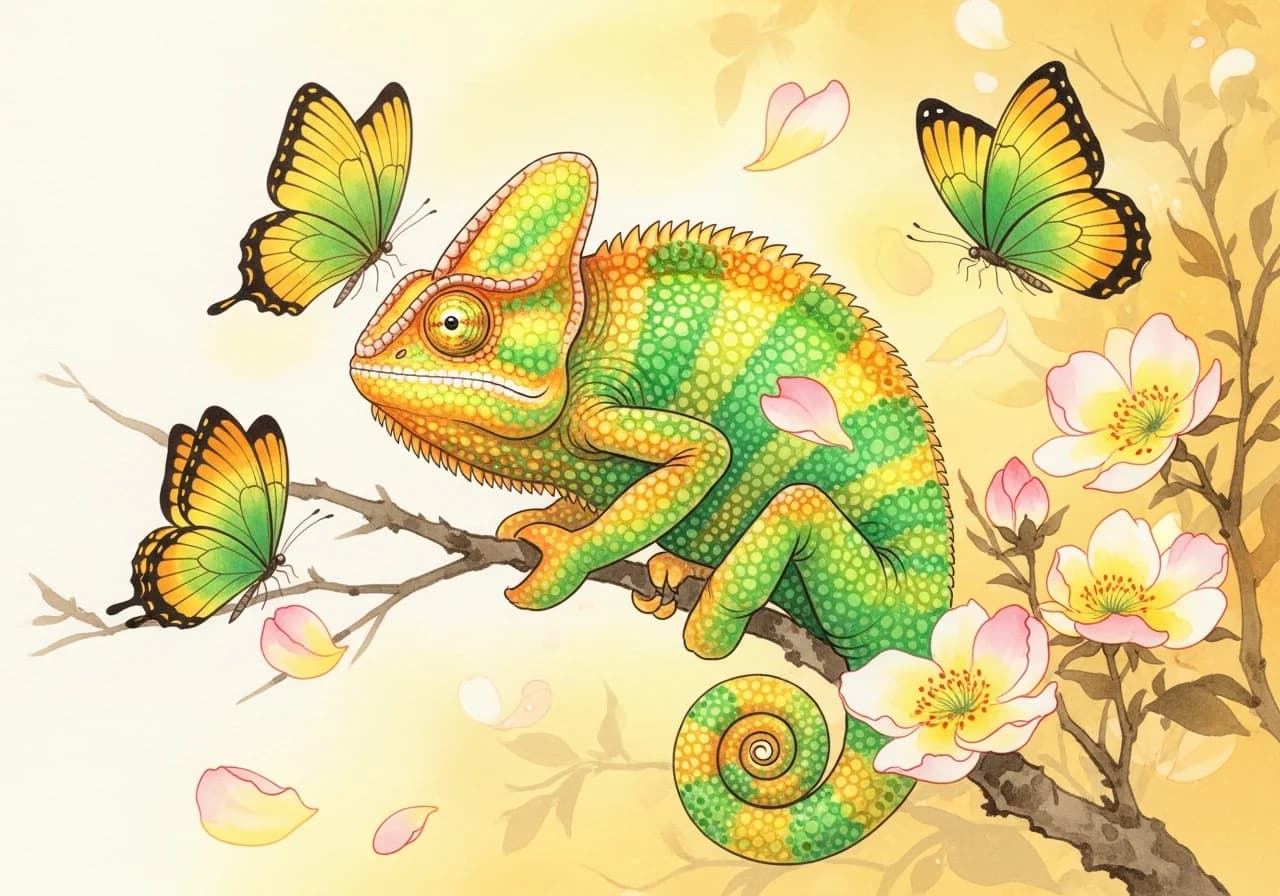
Korean dream interpretation (꿈해몽) divides chameleon dreams sharply based on context. A chameleon that naturally shifts color and harmonizes with its environment is a strongly auspicious omen (길몽), predicting that you will quickly establish yourself and earn recognition in a new workplace or unfamiliar situation. If you are on the verge of a life transition — a new job, relocation, or business venture — this is an encouraging green light from your subconscious. On the other side, a chameleon that hides, attacks you, or loses its color falls into inauspicious territory (흉몽). These variations warn of duplicitous figures nearby, or serve as an internal signal of identity confusion and a loss of direction. Reading the details of your specific dream is what unlocks the real message.
Auspicious Interpretations — Social Agility and Adaptive Success
A chameleon adapting seamlessly to its surroundings by shifting color is one of the more optimistic animal dream omens in Korean tradition. It predicts success at integrating into new organizational cultures, winning over both superiors and peers in unfamiliar settings. For anyone considering a career change or expansion into a new business field, this dream serves as a strong endorsement to take the leap. Seeing a bright green chameleon carries equally good news — green symbolizes hope and a fresh start, suggesting that even if your current circumstances feel difficult, an open and proactive attitude will reliably bring positive results. This is a dream that rewards action over hesitation.
Inauspicious Interpretations — Beware Hidden Faces and Betrayal
A chameleon that fully camouflages and disappears into the background warns that someone nearby is concealing their real intentions behind a friendly face. Watch carefully for those who appear agreeable in front of you while acting differently behind your back. Being bitten or attacked by a chameleon is an even more direct alert: someone you trusted may be planning to deceive or manipulate you. This is particularly relevant for new business partnerships or recently formed close relationships — move carefully before extending full trust. A chameleon that loses its color and turns pale warns of identity erosion — the dream is asking whether you have become so focused on meeting others' expectations that you have lost sight of who you actually are and what you actually want.
Neutral Interpretations — The Wisdom of Waiting
Quietly observing a chameleon without conflict is read as neutral in Korean dream interpretation. The message here is practical: now is not the time to act impulsively. Like a chameleon surveying its environment from a high branch before making a move, gather information, assess the landscape, and act strategically rather than reactively. In competitive workplace or business contexts, reading your rivals' positioning before responding will yield a distinct advantage.
Dream Variations
Chameleon changing color dream
Directly watching a chameleon change its color is an auspicious omen predicting that an upcoming transition — a new job, a move, a new relationship — will proceed smoothly. It also suggests that your ability to adapt will be recognized and valued by those around you. Take this as encouragement to embrace change without fear.
Chameleon hiding dream
A chameleon fully camouflaging itself and vanishing warns that someone in your life is concealing their true motives. Take a second, careful look at the words and actions of anyone you have grown close to recently. Share sensitive plans or decisions only with a small, genuinely trusted circle — and do not dismiss any intuition that something feels off.
Catching a chameleon dream
Catching a chameleon in a dream symbolizes personally identifying and neutralizing a hidden problem or a person who was manipulating you from behind a mask. It is generally auspicious — a sign that you will expose a hidden truth in business or relationships. The catch: if the chameleon bites you after being caught, or escapes, the problem is not fully resolved yet.
Pet chameleon dream
Keeping a chameleon as a pet signals that you are consciously cultivating your own capacity for flexibility and transformation. It is a positive omen of readiness for an upcoming period of change. If the pet chameleon falls ill or dies in the dream, however, it warns that your current strategy for adapting may be under strain.
Chameleon losing color dream
A chameleon that loses its vivid color or fails to shift properly is an inauspicious symbol of identity confusion or a loss of direction. The inner message is pointed: you may be so focused on fitting in or meeting expectations that you are losing your authentic self. This is a prompt to reconnect with your real values and what you genuinely want from life.
Red chameleon dream
A red chameleon carries a warning. It foreshadows hidden conflict or betrayal rising to the surface, and signals that this is a time to curb impulsive words and decisions. If you are involved in any important contracts or new partnerships, look carefully for undisclosed clauses or ulterior motives before proceeding.
White chameleon dream
In Korean folk tradition, white animals are sacred, pure beings. Seeing a white chameleon is a rare auspicious omen associated with spiritual renewal, a genuine fresh start, or stepping onto a path of authentic transformation. It suggests that sincere personal change will bear real fruit — an unusually hopeful sign.
Black chameleon dream
A black chameleon symbolizes a threat completely hidden in darkness. It warns of forces obstructing you in ways that are not yet visible. It can also be a psychological signal that destructive emotions or your own inner resistance are blocking forward movement. This dream invites honest self-examination.
Chameleon in a tree dream
A chameleon perched high in a tree is an auspicious symbol of strategic wisdom — the ability to survey a situation comprehensively before committing to action. Gathering sufficient information before acting, rather than rushing a decision, is the key to success here. In competitive professional settings, reading your rivals before revealing your own move will give you a meaningful edge.
Chameleon flicking tongue dream
A chameleon shooting its tongue to catch prey is an auspicious sign of sharp perception and decisive timing. A good opportunity will move fast — acting without hesitation is how you seize it. If the tongue strikes but misses its target, however, it warns of a missed opportunity or becoming the subject of gossip.
Cultural Context
The chameleon is not native to Korea — it originates in Africa, Madagascar, and the Middle East — so it does not appear in classical Korean folk dream interpretation (꿈해몽). Its symbolic role in Korean culture is a purely modern development. Yet the expression '카멜레온 같은 사람' (someone like a chameleon) has become deeply embedded in contemporary Korean speech, and it carries two conflicting meanings simultaneously. The first is admiring: a person with masterful social agility who adapts seamlessly to any situation. The second is cautionary: an untrustworthy turncoat who reshapes their personality to suit circumstances while hiding their real intentions. This dual valence directly shapes how chameleon dreams are read. Korean culture has always held a complicated relationship with the concept of 'transformation.' Flexible social navigation is genuinely admired as a survival skill in a highly hierarchical society, yet the Confucian value system that underpins Korean social ethics prizes 의리 (loyalty) and consistency. A person reputed for being too adaptable is often held at arm's length as fundamentally untrustworthy. That tension — between pragmatic flexibility and principled consistency — runs straight through Korean readings of the chameleon dream. The broader symbolic tradition around reptiles in Korean folklore also informs these interpretations. Snakes, lizards, and related creatures have long been associated with financial fortune and tenacious vitality, while simultaneously serving as warnings of hypocrisy and betrayal. Chameleon dreams inherit this layered reptile symbolism, amplified by the chameleon's defining trait of disguise — which makes the 'duality vs. truth' theme especially pronounced.
Western Psychological Perspectives
Western psychology brings a rich interpretive lens to chameleon dreams, centering on the tension between social adaptation and authentic identity. From a Freudian standpoint, the chameleon represents the conflict between the ego and superego. The chameleon's perpetual reshaping to match its environment mirrors the psyche suppressing its authentic self in pursuit of social acceptance and approval. Dreams of being threatened by a chameleon reflect the repressed desire for authenticity pushing toward consciousness — an inner need to stop performing and simply be. Catching or subduing the chameleon, by contrast, symbolizes the ego asserting control over a hypocritical persona it has been hiding behind.
Jungian analytical psychology offers the most direct framework for chameleon dreams through its Persona archetype. The Persona is the social mask we wear to fulfill our different roles — and the chameleon's color-shifting is almost a literal enactment of this concept. A chameleon dream may warn that the gap between your Persona and your true Self (with a capital S) is widening dangerously. It can also signal a crisis in the individuation process — the lifelong journey toward psychological wholeness — when over-identification with the persona causes a person to lose touch with their authentic core. The act of recognizing the chameleon's colors in the dream is interpreted as psychological growth: beginning to integrate the hypocritical, shape-shifting aspects of the Shadow into conscious awareness.
Modern psychology links chameleon imagery to the well-documented 'chameleon effect' — our unconscious tendency to mirror others' behavior, posture, and mannerisms. An excessive version of this tendency reflects heightened approval-seeking or underlying identity anxiety. Chameleon dreams also appear frequently in the context of burnout: they symbolize the emotional exhaustion that accumulates when someone has been constantly reshaping themselves to meet others' expectations, functioning as an inner call to reclaim a sense of self.
Across world cultures, the chameleon's symbolic range is striking. In many African traditions it is ominous; in Madagascar, its entry into a home portends death. Middle Eastern Islamic tradition holds a green chameleon as a sign of positive change through difficulty. Shakespeare used the chameleon as a symbol of hypocrisy, while Latin American traditions tend to read it as an emblem of wisdom through harmony with nature. The chameleon is, in this sense, a truly cross-cultural mirror for the universal human tension between fitting in and being real.
Frequently Asked Questions
The chameleon dream is one of the most context-sensitive omens in Korean dream tradition. A chameleon that adapts boldly and blends in is a genuine signal that your own flexibility and social skill are about to work powerfully in your favor. A chameleon that hides, attacks, or loses its color is a prompt to look more carefully at what — and who — may not be what they seem. Whatever direction your chameleon dream pointed, its core message is the same: in times of change, the most valuable thing you can protect is your own authentic sense of self.
Related Dreams
Lizard Dream Meaning — Regeneration, Transformation, and Dual Fortune
Snake Dream Meaning — Korean Dream Interpretation Complete Guide
Crocodile Dream Meaning — Hidden Danger and the Power to Overcome It

Frog Dream Meaning: Decoding Wealth, Transformation, and Warning Signs
Fox Dream Meaning: What Does a Fox in Your Dream Signify?

Transforming Into an Animal Dream — Meaning & Interpretation