Confusion Dream Meaning - Lost, Crossroads, and Chaos in Korean Dream Interpretation
If you woke up from a dream where you couldn't find your way and everything felt disorienting, Korean dream tradition has a nuanced take on what that means — and it may not be what you expect. Confusion dreams (혼란스러운 꿈) have long been understood in Korean folk belief as the mind's honest signal that something in waking life deserves attention, whether a looming decision, a buried conflict, or the natural anxiety of major change. Here's the thing though: whether this dream is a good omen or a warning depends almost entirely on how it ends.
When a Confusion Dream Is Auspicious (길몽)

In Korean dream interpretation (해몽), a confusion dream becomes auspicious — 길몽 — when the chaos resolves within the dream itself. If you eventually find your way, the situation clears, or you wake feeling relieved rather than distressed, the dream is read as a sign that you will overcome a current difficulty and discover a new path forward.
Perhaps the most surprising interpretation: crying while confused in a dream is traditionally considered a positive sign. This is understood as emotional catharsis — a purging of long-accumulated stress and anxiety. The tearful release signals that the inner healing process has already begun. Dreams where you successfully escape a chaotic situation are similarly auspicious, foretelling that a complicated chapter of real life is about to close and a new one will begin.
When a Confusion Dream Is Inauspicious (흉몽)
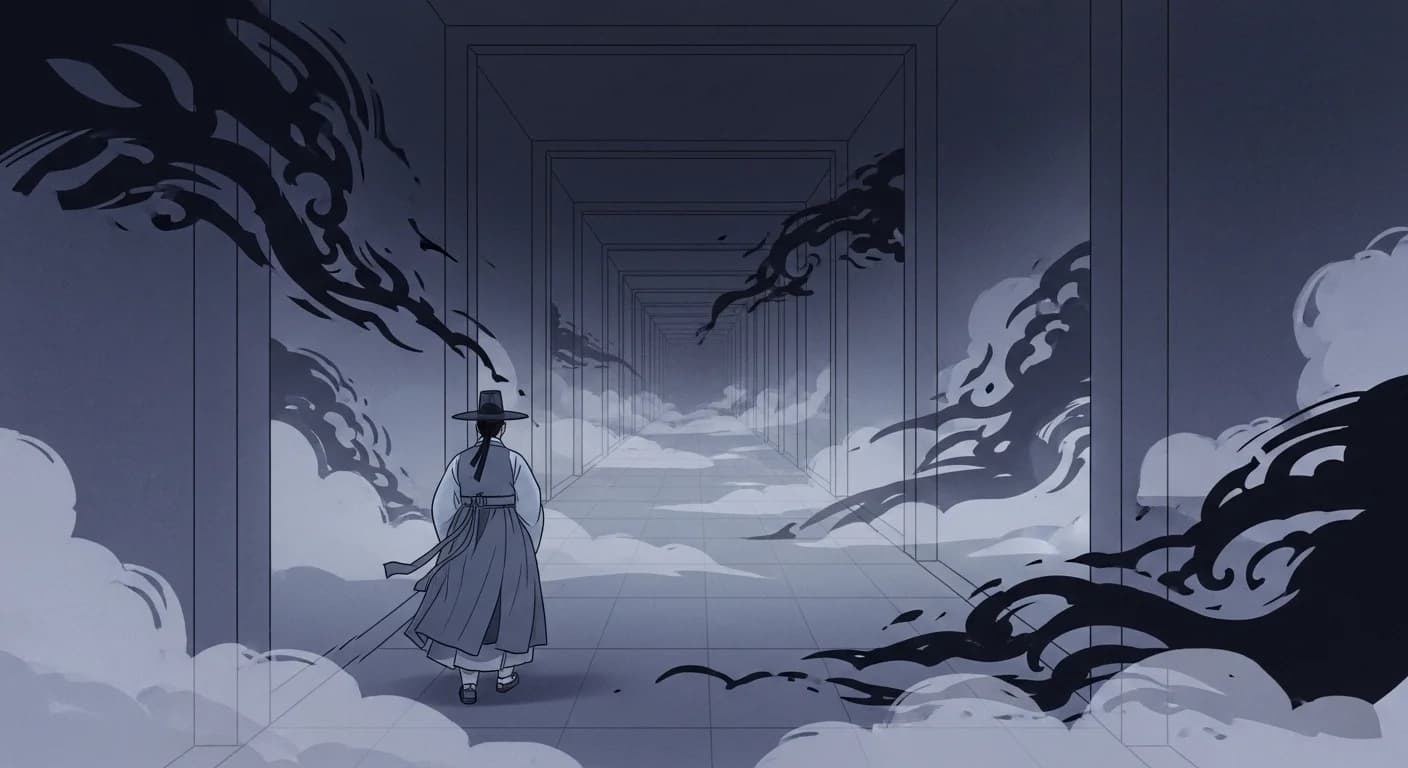
The dream turns inauspicious — 흉몽 — when the confusion only deepens with no resolution in sight. Being frozen at a crossroads, lost in an endless maze, or watching the chaos escalate without escape are all read as warnings that your decision-making ability is compromised in waking life, or that you are actively avoiding a problem that needs confronting.
Recurring confusion dreams amplify this warning significantly. When the unconscious mind replays the same chaotic scenario night after night, Korean tradition and modern psychology both agree: something unresolved is demanding your attention. It is worth examining honestly whether there is an ongoing conflict at work, in a relationship, or in a financial matter that you have been sidestepping.
Context-Dependent Interpretations
Confusion dreams are strongly tied to the dreamer's real-life circumstances. Dreaming of disorientation in an unfamiliar place when you are about to change jobs, move cities, or start a new relationship is often simply the mind processing the natural anxiety of transition — not a bad omen, just an honest reflection of how unsettled you feel.
Dreams of being overwhelmed in a crowded, noisy environment often point to social pressure and the weight of others' expectations. If you manage to find a familiar face or a way through the crowd in the dream, it can be read as a sign that you will find support and grounding within your social circle.
Dream Variations
Getting Lost in a Dream
Wandering without direction is the most common form of confusion dream. It symbolizes real-life hesitation before a major decision or a sense of lost purpose — common when you face too many options in your career, studies, or relationships and cannot commit to any of them. If you eventually find your way despite the wandering, the dream carries an optimistic undertone: the path exists, you just haven't seen it clearly yet.
Escaping a Chaotic Situation in a Dream
Successfully breaking free from chaos is one of the clearest auspicious confusion dreams. It signals that a complicated real-life situation is on its way to resolution and that a new chapter is approaching. The more vivid and relieving the escape — especially if the landscape brightens after you get out — the stronger the omen of positive change.
Crowded and Chaotic Place in a Dream
Being unable to orient yourself among surging crowds reflects feelings of social alienation or the weight of others' expectations bearing down on you. It often appears during periods when you feel invisible or overwhelmed by what people around you demand. Spotting a familiar face in that crowd, however, flips the meaning toward hope — a signal that support is closer than it feels.
Standing at a Crossroads in a Dream
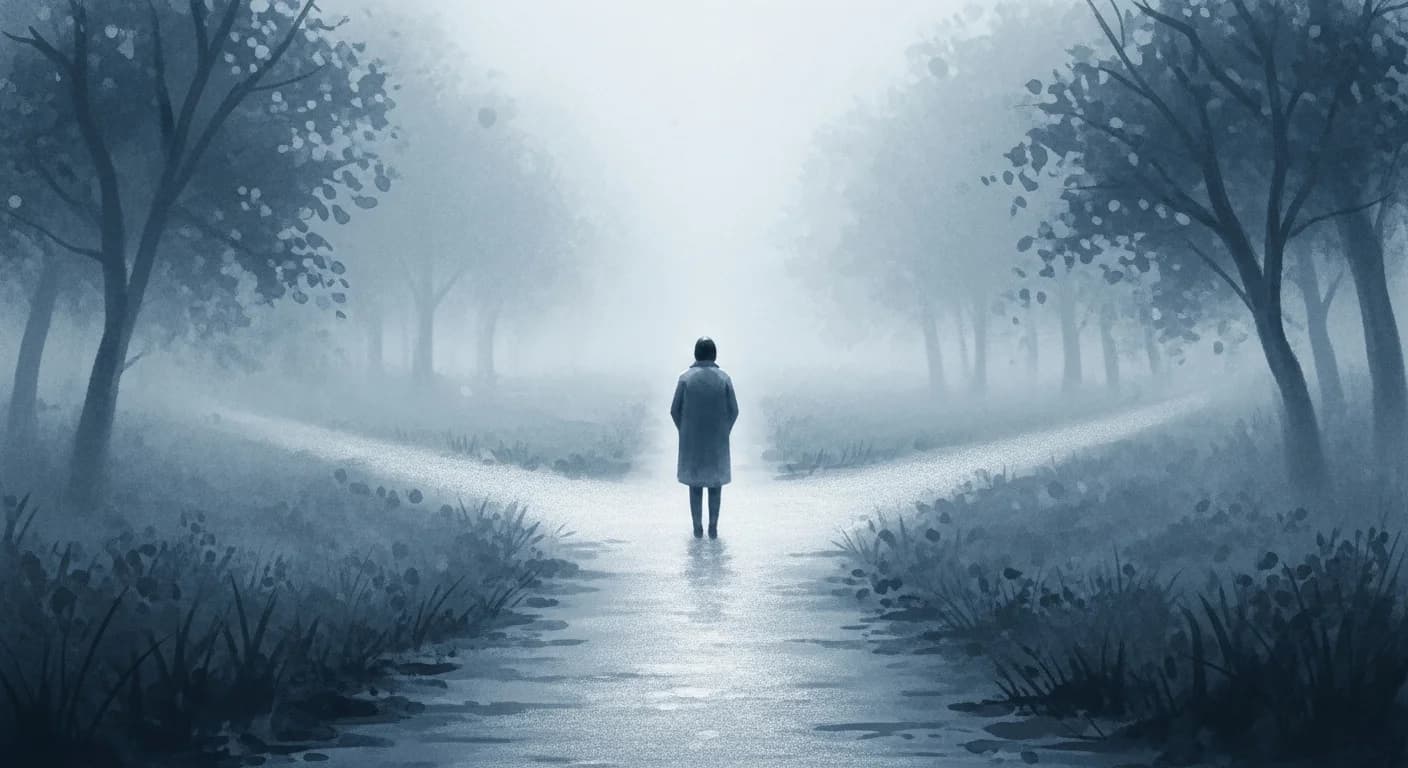
A crossroads where you cannot choose a direction is a direct mirror of real-life decision paralysis. Korean dream interpretation reads this as a signal that a significant choice has arrived but fear is holding you back. When the dream ends with you actually stepping forward — choosing a path — it becomes an encouraging sign that the courage to decide is already forming within you.
Crying While Confused in a Dream
Paradoxically, tears during a confusion dream are a positive sign in Korean dream tradition. The crying represents emotional catharsis — the release and purification of real-world tension. If you woke up after this kind of dream feeling lighter or unexpectedly calm, trust that feeling. The inner pressure-release valve has opened, and healing is underway.
Confused in an Unfamiliar Place in a Dream
Total disorientation in an unknown environment reflects anxiety about new circumstances. This dream is especially common before a major life transition: a new job, a new city, a new relationship. Rather than reading it as a bad omen, think of it as your mind running a stress test on the upcoming change — uncomfortable, but a sign that you are taking the transition seriously.
Recurring Confusion Dreams
When the same chaotic dream keeps returning, the unconscious is flagging an unresolved issue with increasing urgency. One or two confusion dreams can be a normal stress response; a recurring pattern is a stronger signal. Modern psychology and Korean folk tradition both recommend the same first step: instead of dreading the dream, ask what unconfronted conflict or suppressed feeling might be fueling it.
Cultural Context
Korean dream interpretation (해몽) has roots stretching back millennia, drawing from Confucian thought, shamanic (무속) tradition, and Buddhist ideas about the mind's relationship to reality. Dreams are not dismissed as random noise — they are understood as windows through which ancestral spirits, divine forces, or the unconscious mind communicate with the dreamer.
Confusion dreams specifically have long carried the meaning of 마음이 흔들린다 — 'the heart is wavering' — and are well-documented in traditional texts as appearing during periods of major decision-making, family conflict, or business crossroads. Importantly, Korean folk belief holds a concept called 역몽 (yeongmong), or 'reverse dreams,' where a chaotic or frightening dream may actually portend peace and clarity in waking life. This idea runs deep in everyday Korean culture — many people still recount stories of nightmares that preceded good fortune.
Within shamanic practice, persistent confusion dreams could be interpreted as an intrusion of inauspicious energy (부정한 기운), sometimes addressed through ritual cleansing ceremonies (굿) or protective talismans (부적). While these practices are less common today, the underlying attitude — that disturbing recurring dreams deserve to be taken seriously and not ignored — remains part of how many Koreans relate to dream life.
Western Psychological Perspectives
Western psychology approaches confusion dreams through several overlapping lenses, each shedding a different light on why the disoriented dream state occurs and what it might mean.
Sigmund Freud saw the chaotic, non-linear quality of confusion dreams as the signature of the psyche's censorship mechanism at work. When the mind cannot allow a suppressed desire or unresolved conflict to surface directly, it scrambles the narrative — producing the disorientation we experience as confusion. The dream's disorder, for Freud, is not meaningless: it is precisely structured to obscure something the dreamer is not yet ready to confront consciously.
Carl Jung offered a more generative reading. He saw confusion dreams as surfacing the tension between the conscious ego and the deeper layers of the psyche — the shadow, or the integrated Self. This chaos reflects a crisis phase in the individuation process, the lifelong journey toward psychological wholeness. Crucially, Jung did not view this chaos as merely negative: the confusion may be the creative disorder that always precedes a genuine transformation of identity. He would read such a dream as an invitation from the unconscious — a call to integrate what has been split off or ignored.
Contemporary cognitive neuroscience offers a more physiological explanation. REM sleep is the brain's primary workshop for processing emotional experiences, and confusion dreams tend to emerge when the emotional processing load exceeds what can be neatly organized. Studies consistently find higher rates of chaotic, disorienting dream content among people experiencing chronic anxiety, burnout, or major life transitions — exactly the circumstances that Korean tradition has always associated with this type of dream.
What is striking across all three frameworks — Freudian, Jungian, and neuroscientific — is a shared conclusion: a confusion dream is not a malfunction. It is the mind, in its own way, insisting that something deserves your waking attention.
Frequently Asked Questions
A confusion dream is not a nightmare to be dreaded — it is your inner life being honest with you. The chaos you felt in the dream reflects something real: a decision waiting to be made, an emotion waiting to be felt, or a change you have not yet accepted. Pay attention to how the dream ended, keep a journal if the confusion keeps returning, and treat the dream as an invitation rather than a threat. The fact that your mind is working this hard — even while you sleep — is a sign of how seriously you are taking the challenges in front of you.