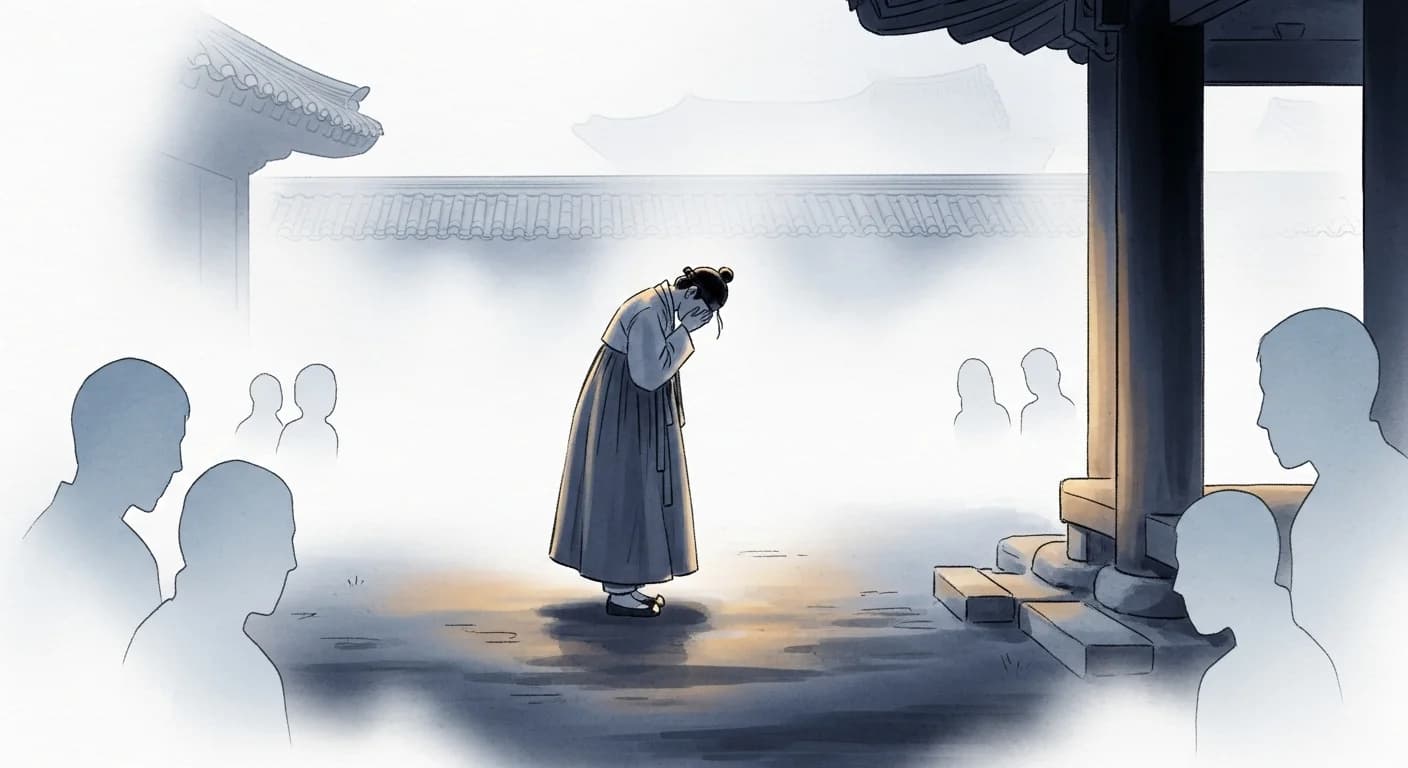
Guilt Dream Meaning — What Your Unconscious Is Trying to Tell You
If guilt pressed down on your chest in last night's dream, Korean dream tradition sees that feeling not as a warning to fear, but as a knock from your unconscious mind asking you to pay attention. Emotions in dreams have long been treated in Korean 해몽 (dream interpretation) as real signals tied to your waking fortune — not mere psychological noise. Here's the thing though: a guilt dream doesn't automatically signal bad luck. How the dream unfolds — whether it ends in confrontation or flight — determines everything.
Understanding Guilt Dreams — The Core Framework
In Korean dream interpretation, feeling guilt in a dream reflects unresolved regret, suppressed conflict, or interpersonal tension rising from the unconscious into your sleep. The brain revisits emotionally charged material during REM sleep, and guilt — particularly when attached to a real-life relationship or past action — tends to resurface in this way. The key to reading a guilt dream lies in its emotional arc: does the dreamer confront the guilt and move toward resolution, or run from it? That single detail shifts the interpretation from ominous to hopeful, or vice versa.
Auspicious Guilt Dreams — Signs of Healing and Growth

When a guilt dream progresses into apologizing, being forgiven, or making peace with someone, Korean dream tradition reads this as a genuinely positive omen. It signals that the dreamer's unconscious is preparing to acknowledge wrongdoing and seek reconciliation — a psychological readiness for healing that often precedes real-world breakthroughs in relationships. Waking up from such a dream feeling lighter, rather than heavy, is confirmation that inner emotional processing is already underway. These dreams often appear when the conditions for genuine reconciliation are ripening in waking life.
Inauspicious Guilt Dreams — A Warning About Avoidance
When guilt in a dream is paired with oppressive fear — running, hiding, or being chased — Korean tradition interprets this as a cautionary signal. It suggests that unresolved past mistakes, hurt caused to someone close, or moral burdens not yet fully acknowledged are deepening as a psychological weight in waking life. The act of running away in the dream mirrors an avoidance pattern: something real is being sidestepped. If the heavy feeling lingers throughout the day after this kind of dream, it is worth asking honestly what you may be avoiding.
Guilt Dreams and Your Relationships
Guilt dreams frequently reflect tension in specific relationships. When a particular person appears in the dream as the object of your guilt, it is a reliable sign that something between you and that person remains unfinished — an apology not made, a conversation not had. Korean dream readers consider it especially significant when the other person in the dream accepts the apology or reconciles: in such cases, the conditions for real-world repair may already be in place. Conversely, if the person turns away or responds with anger in the dream, it suggests the timing for reconciliation in waking life is not yet right.
What Guilt Dreams Say About Your Psychological Health
A guilt dream is not a sign of psychological dysfunction — quite the opposite. The capacity to feel guilt, even in sleep, reflects an active moral conscience and functioning self-reflection. Modern psychology frames these dreams as the brain's healthy self-regulatory process, not a symptom of anything to treat. The more meaningful question is what the guilt dream is pointing to. If the same guilt dream recurs, the unconscious is signaling that something in waking life needs direct confrontation, not continued avoidance.
Dream Variations
Dream of Apologizing to Someone
Sincerely apologizing in a dream reflects the unconscious desire to resolve a long-standing conflict. The act of seeking forgiveness is itself a positive sign of self-reflection, suggesting that reconciliation or emotional resolution is drawing close in waking life.
Dream of Confessing a Wrongdoing
Confessing a wrongdoing in a dream represents suppressed guilt surfacing. If the feeling afterward was relief rather than dread, it signals that honest communication in waking life could lift a psychological burden you have been carrying.
Dream of Being Chased Out of Guilt
Being chased because of guilt reflects psychological pressure from unresolved past mistakes or moral conflicts. The act of running away mirrors an avoidance pattern in waking life, suggesting the time has come to face the issue directly rather than continue fleeing it.
Dream of Crying from Guilt
Crying from guilt in a dream represents an emotional release — a kind of psychological purification of long-suppressed feelings. Waking up feeling lighter afterward is a positive sign that inner emotional processing is underway and the burden is beginning to lift.
Dream of Feeling Guilty Without Cause
Feeling guilty in a dream without having done anything wrong may connect to unjust criticism received in waking life, an outsized sense of responsibility, or low self-esteem. The dream signals that you may be holding yourself to an unreasonably harsh standard.
Dream of Feeling Guilty Toward a Deceased Person
Feeling guilt toward someone who has died is interpreted in Korean tradition as an unresolved spiritual bond with the departed. Observing memorial rites, or privately making peace with that person's memory, is thought to bring psychological comfort and help the dream resolve.
Cultural Context
In traditional Korean dream interpretation (꿈해몽), emotions experienced during a dream were not treated as mere psychological byproducts — they were meaningful signals directly tied to the dreamer's waking fortune. Dreams involving guilt or moral conflict were sometimes read as messages from ancestral spirits or protective deities warning the dreamer of unfinished moral business. This reading is rooted in the Confucian tradition that shaped Korean society for centuries, where moral self-cultivation (修身, sushin) was understood as a fundamental social and personal duty. Experiencing guilt in a dream signaled that inner refinement was still incomplete — a call to moral reckoning rather than a verdict of doom. Korean shamanic belief (무속 신앙) added another layer: intensely negative emotions in dreams could indicate the presence of restless spirits or unresolved spiritual bonds, with ritual resolution through prayer or ceremony recommended as a remedy. Alongside these cautionary readings, the Korean folk principle of 'dream-reality inversion' (꿈-현실 역전) offered a hopeful counterpoint — suffering and guilt in a dream might presage sincere reflection and growth in waking life, transforming the uncomfortable dream into a promise of positive change.
Western Psychological Perspectives
Freud interpreted guilt-laden dreams as evidence that the superego continues its moral surveillance even during sleep. When repressed desires or taboo impulses surface in the dream state, the superego imposes guilt as a form of psychic punishment — the dreamer's internal moral authority penalizing the unconscious for what it reveals. In Freudian terms, guilt in dreams is the raw expression of inner conflict between the id's drives and the superego's demands, playing out without the ego's usual mediation.
Jung offered a very different — and more constructive — reading. He connected dream guilt to the Shadow archetype: the rejected, unacknowledged aspects of the self that the conscious mind has pushed aside. Rather than treating guilt dreams as punishments, Jung saw them as invitations from the unconscious to integrate the Shadow and advance toward psychological wholeness (individuation). A guilt dream, in this framework, is not an accusation but an opportunity — a call to be honest with yourself about what you have been unwilling to see.
Modern sleep science and cognitive psychology bridge the clinical and the experiential. Research on REM sleep shows that the amygdala — the brain's emotional processing center — is highly active during this stage, and unresolved guilt, interpersonal conflict, and moral dilemmas are exactly the kind of emotionally charged material that surfaces as dream narrative during REM. Far from pathological, this process is the brain's healthy emotional self-regulation: sorting, processing, and seeking resolution for what the waking mind left unfinished.
What unites these Western perspectives with Korean dream tradition is a shared conclusion: suppression is not the answer. Whether the interpretation is ancestral warning, Jungian shadow work, or REM-stage emotional processing, both traditions point toward the same resolution — confronting what the dream surfaces, rather than turning away from it.
Frequently Asked Questions
A guilt dream is uncomfortable by design — your unconscious doesn't knock softly when it has something important to say. Rather than dismissing it, treat the dream as a map: it is pointing somewhere real. Whether that somewhere is a relationship you have been avoiding, a conversation you have been postponing, or simply a standard you have been holding yourself to too harshly, the dream has done its job by surfacing it. What you do with that signal is where the real work begins.