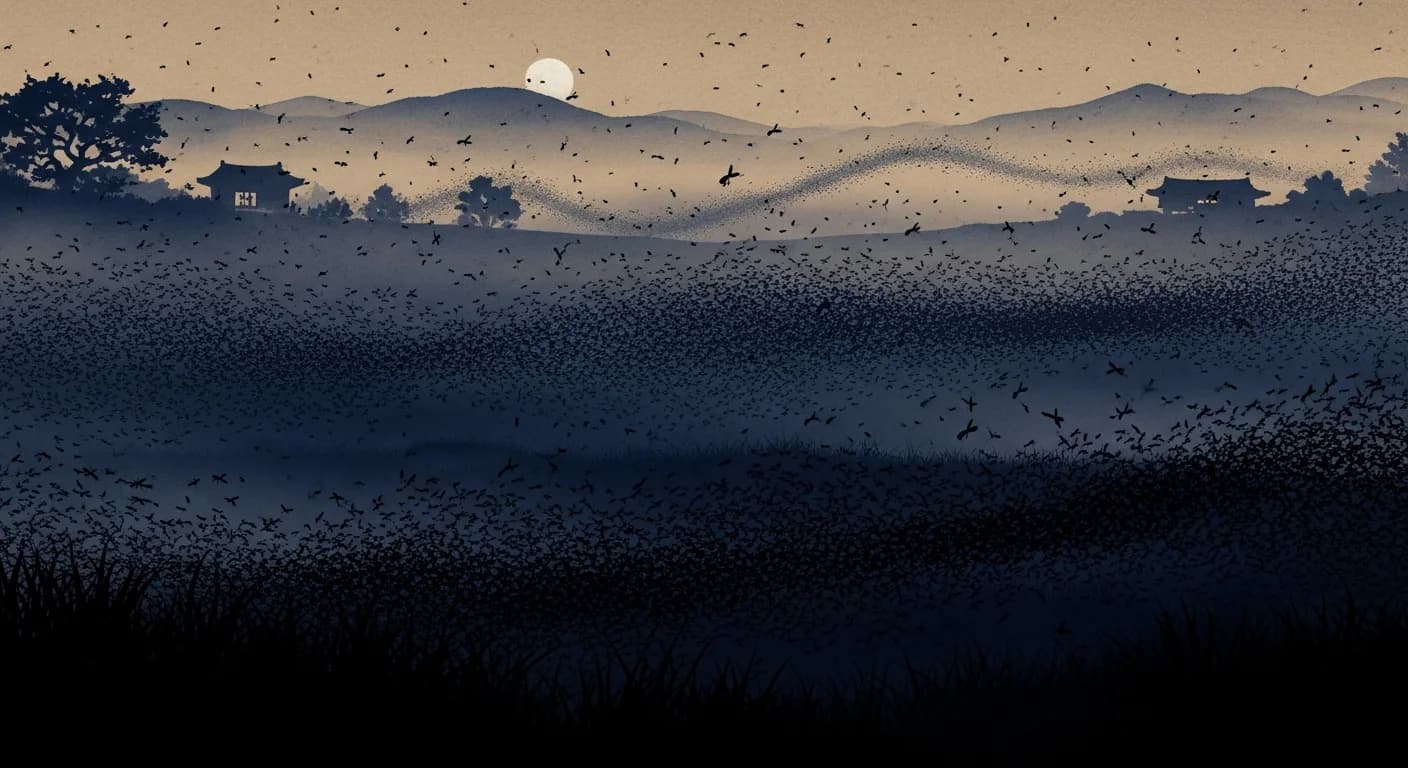
Dream of a Swarm of Insects: What Korean Dream Interpretation Says
If a mass of insects invaded your dream last night, Korean folk dream tradition has a clear message: something in your waking life has grown beyond your capacity to manage it alone. The swarm is one of the most viscerally anxiety-laden symbols in Korean dream interpretation (꿈해몽) — not because insects are merely disgusting, but because the swarm itself represents collective, uncontrollable force bearing down on the individual. Here's the turning point though: how you responded to that swarm in your dream completely transforms the meaning.
When a Swarm Dream Is an Inauspicious Omen (흉몽)
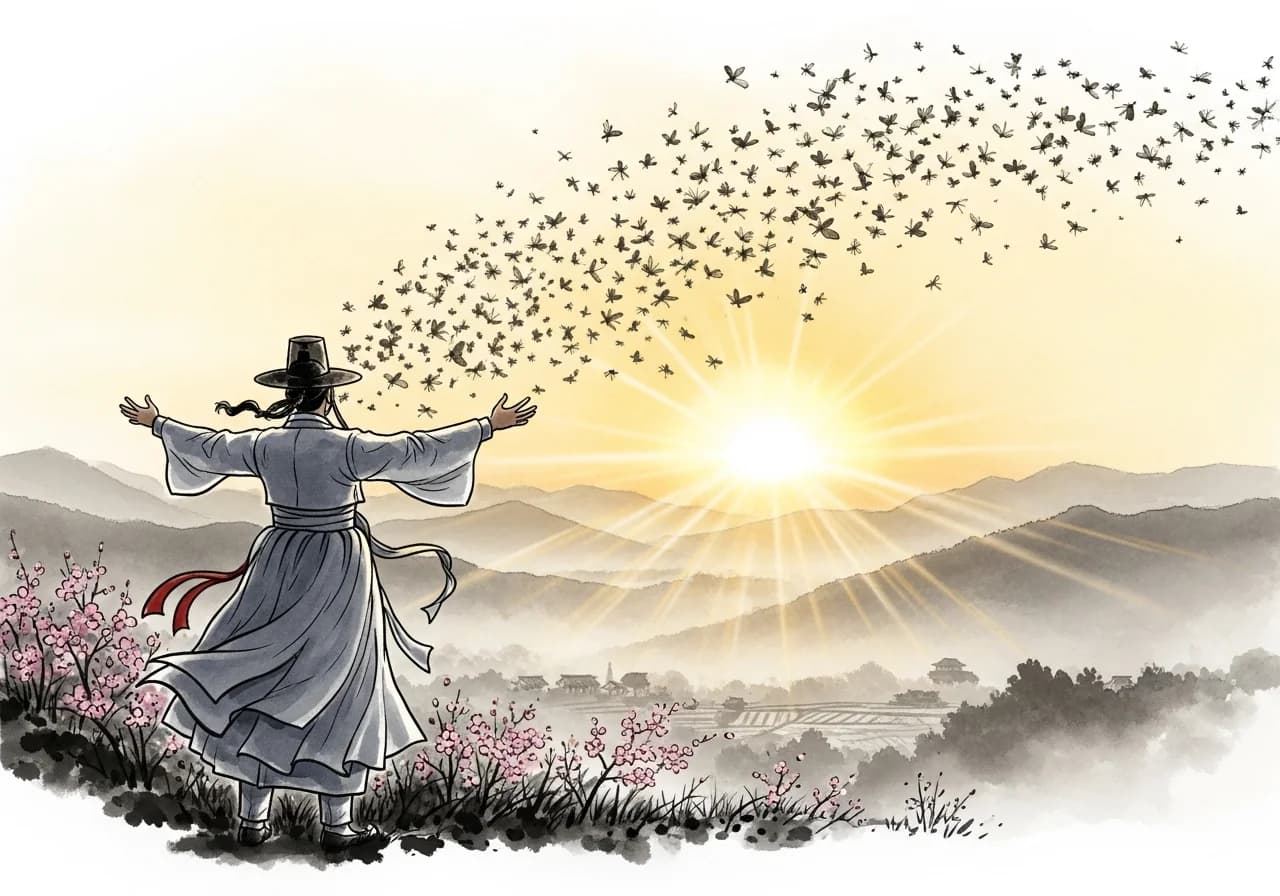
A swarm converging on you from all sides — especially one that leaves you feeling helpless or overwhelmed — is generally read as an inauspicious omen (흉몽) in Korean dream interpretation. It signals that multiple problems or pressures in waking life are piling up simultaneously, creating a sense of being unable to cope. The sheer uncontrollable mass of the swarm mirrors exactly that: the psychological state of someone facing too many stressors at once.
When the insects crawl on or cling to your body, the omen sharpens. This variation warns specifically of interpersonal conflict, workplace pressure, or unresolved inner turmoil that has been suppressed for too long. A swarm entering your home carries a similar warning — unwanted people intruding on your personal space, possible family discord, or health concerns requiring attention. The home in Korean dream symbolism represents the self and domestic harmony, so an invasion is taken seriously.
When Driving the Swarm Away Becomes a Good Omen (길몽)
The swarm dream is not universally bad. If you successfully drove the insects away or eliminated them in your dream, Korean tradition reads this as a strongly auspicious sign (길몽) — a declaration that you have the will and strength to overcome the complex difficulties currently facing you. The act of expelling the swarm symbolizes decisive, effective action that clears a path forward.
There is also a more surprising good omen within this category: finding a swarm of small, non-threatening insects gathered inside a closed space like a wardrobe or storage room is interpreted as a wealth accumulation omen. Fortune is quietly building in hidden places, out of direct view — an unexpected windfall or growth in savings may be on the way.
Wealth Fortune and the Insect Swarm
Korean folk belief has long connected certain insects to financial luck. The money bug (돈벌레, literally 'money worm') entering the home was traditionally considered a welcome omen of incoming wealth — a reflection of agrarian beliefs that connected soil creatures to fertile, prosperous land. By extension, dreams of small, harmless insects congregating in enclosed domestic spaces carry a similar reading.
In contrast, insects swarming over food is an inauspicious sign that assets or hard-won achievements may be undermined by outside forces. It serves as a call to reinforce boundaries around what you value most.
Relationships and Work: What the Swarm Reveals
Swarm dreams are particularly revealing when it comes to social and professional dynamics. Being attacked by a swarm warns of unexpected criticism, gossip, or collective pressure from people around you — a caution to be mindful of your words and actions in group settings, especially at work.
Flying insects swarming around without attacking represent a different but equally real anxiety: unpredictability and instability in your environment. You may feel that the situation is spinning beyond your control, and relationships are adding to the pressure rather than relieving it. The dream is an invitation to slow down and observe before acting.
Dream Variations
Swarm of Insects Covering Your Body
Insects swarming over your entire body is a strong inauspicious omen warning of intense inner conflict — possibly a struggle between right and wrong impulses, or a temptation toward behavior you know is not aligned with your values. It is a call for mental discipline and self-restraint before making any significant decisions.
Swarm Entering Your House
A swarm invading the home represents unwanted intrusion into personal space — troublesome people, family conflict, or external problems encroaching on domestic life. The severity depends on the type and scale of the swarm. Note that specific insects (such as the traditional 'money bug') entering the home are actually read as a positive wealth omen.
Being Attacked by a Swarm of Insects
An insect swarm that actively attacks you is an inauspicious sign suggesting that unexpected criticism, gossip, or group pressure from your social circle or workplace is coming. It advises particular care in communication and a watchful eye on those around you.
Watching a Swarm from a Distance
Observing a swarm from a safe distance without being involved is a neutral omen. It suggests complex situations are unfolding in your surroundings without directly impacting you yet — an invitation to watch carefully and respond with measured caution rather than impulsive reaction.
Chasing or Catching a Swarm
Successfully chasing or eliminating a swarm is one of the most auspicious outcomes within this dream category. It signals that you have the capacity to resolve complex, overlapping problems one by one, and that mental peace will ultimately be restored after a challenging period.
Dream of Dead Insects in a Swarm
Finding a mass of dead insects in your dream is an auspicious omen: the troubles and worries that have been weighing on you are finally coming to an end. Accumulated stress is dissolving naturally, and the situation around you will improve.
Flying Insects Swarming Around You
A chaotic cloud of flying insects surrounding you represents an unstable, unpredictable environment. The swarm's erratic movement mirrors a sense that circumstances are beyond your control, and interpersonal stress may be building. Grounding routines and clear communication can help.
Swarm of Insects on Food
Insects swarming over food in your dream warns that your resources, achievements, or assets may be at risk from external interference. It is a signal to protect what you have worked hard to build and to be vigilant about who has access to your efforts.
Cultural Context
In Korean folk belief, insects occupy a dual symbolic space. On one side, they represent decay, contamination, and the slow, invisible harm that gnaws at things from within; on the other, certain insects are deeply connected to earth's fertility and abundance. The agricultural roots of Korean culture meant that soil creatures — from earthworms to millipedes — were associated with a living, healthy land that could produce wealth. Dreams of specific insects entering the home were therefore read as wealth omens, a conceptual link that persists in contemporary Korean dream interpretation.
In Korean shamanic tradition (무속 신앙), swarms of insects could signify the presence of malevolent spirits or an accumulation of impure energy (부정한 기운) in the household. An infestation in the home might indicate that the household spirits were displeased, and ritual cleansing — through ceremony or offering — was sometimes performed in response.
Overall, in traditional Korean dream interpretation, an insect swarm is understood as an image of uncontrollable chaos, collective threat, or a surge of suppressed emotions finally breaking through — a signal that multiple forces, whether external pressures or inner anxieties, have reached a tipping point and can no longer be ignored.
Western Psychological Perspectives
From a Freudian perspective, dreaming of an insect swarm represents the collective eruption of repressed anxieties, guilt, or obsessive thoughts from the unconscious mind. The image of countless insects covering the body or invading the home symbolizes the id's uncontrollable instincts breaking through the ego's defenses. Freud linked dreams involving disgusting or unclean creatures to sexual repression or moral guilt surfacing in disguised form. The tactile sensation of insects crawling on skin — even in a dream — speaks directly to anxieties about bodily boundaries and the integrity of the self.
In Jungian analytical psychology, a swarm of insects connects to the Shadow archetype — those aspects of the self that the conscious ego refuses to acknowledge. Each individual insect in the swarm can be read as a fragment of a suppressed complex: a feeling, memory, or impulse that has been pushed down rather than processed. The swarm as a whole represents these fragments knocking collectively on the door of consciousness. Jung would read such a dream as a signal within the individuation process — the lifelong work of integrating the full range of the psyche, including its darker elements. Overcoming the swarm, then, suggests a successful confrontation with the Shadow and a step toward greater psychological wholeness.
Modern cognitive neuroscience and clinical psychology offer a more physiological reading: swarm dreams are the sleeping brain's processing of extreme stress, burnout, or generalized anxiety. When the brain's emotional regulation system is overloaded during waking hours, it expresses that overwhelm through threatening imagery during sleep — the swarm being a particularly apt metaphor for the experience of multiple simultaneous stressors. Research consistently links high-stress periods to more frequent dreams featuring threatening swarms or masses of creatures.
What is striking is how closely Western psychology and Korean folk interpretation converge on the essential meaning. Korean tradition frames the swarm as an external collective threat; Western psychology frames it as an internal projection of complexity. Both traditions agree that the swarm stands for something overwhelming — a complexity the individual cannot manage alone — and both recognize that how the dreamer responds to it carries the real interpretive weight.
Frequently Asked Questions
The swarm of insects dream is ultimately a mirror — one that reflects how much pressure you are carrying right now, and whether you are facing it or fleeing it. If the swarm overwhelmed you, take it as a prompt to look honestly at what in your life has grown too complex to carry alone. If you drove it away, trust that signal: you have more strength than you realize. Either way, this dream is not something to fear — it is something to listen to.
Related Dreams
Cockroach Dream Meaning — Korean Dream Interpretation (꿈해몽)
Ant Dream Meaning — What Korean Dream Tradition Says About Your Ant Dream
Fly Dream Meaning in Korean Folk Interpretation
Mosquito Dream Meaning — What Korean Dream Tradition Says
Spider Dream Meaning — The Dual Symbol of Fortune and Warning in Korean Dream Lore
Centipede Dream Meaning — Korean Interpretation from Fortune to Warning