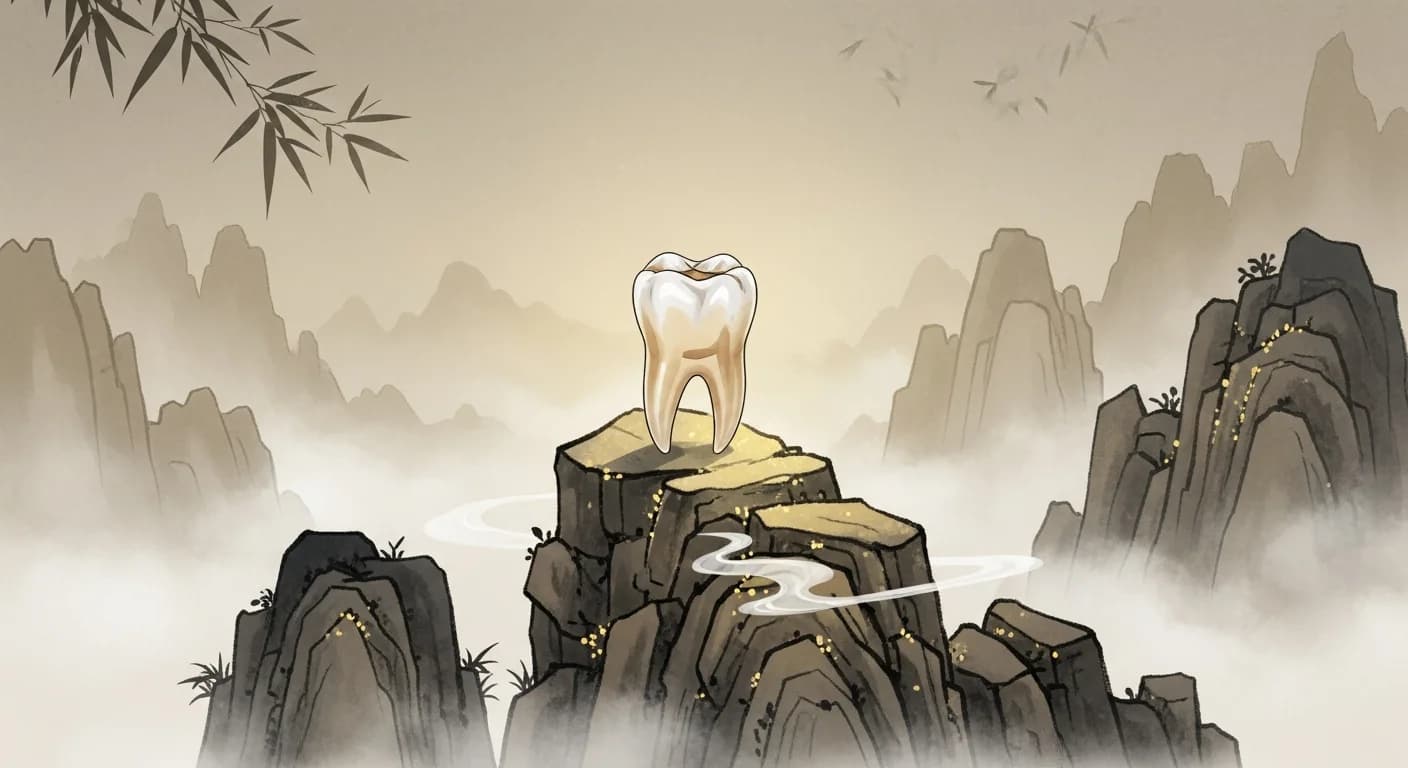
Wisdom Tooth Dream Meaning — Freedom from a Long-Overdue Burden
If a troubled wisdom tooth finally fell out in your dream, Korean dream tradition reads that as a clear signal: something that has been weighing on you for far too long is about to end. In Korean folk interpretation (해몽), teeth are a map of your relationships, and wisdom teeth — which appear late in life and often cause more trouble than they're worth — occupy a special symbolic position. Here's the twist worth knowing: whether this dream is a good omen or a warning depends almost entirely on the condition of the tooth before it fell.
Auspicious: Liberation from a Long-Standing Burden

When a wisdom tooth that has been painful or troublesome finally falls out in a dream, it is a strong good omen (길몽). The symbolism is direct: whatever has been festering — an uncomfortable situation at work, a conflict that refuses to resolve, a relationship that has become more burden than joy — is finally reaching its natural conclusion. Like the relief after a toothache disappears, expect a period of genuine lightness after what has felt like a chronic drain. When the tooth falls out painlessly, the omen is even more positive: the feared resolution will arrive more smoothly than anticipated, possibly eliminating unnecessary financial costs or obligations along the way.
Auspicious: A New Arrival Is Coming
If a new tooth grows in the place where the wisdom tooth fell out, the dream is predicting a new 'youngest member' entering your close circle. This could be a newborn arriving in the family, a junior colleague joining your team, or a new romantic connection beginning. The regenerative image — empty space giving way to new growth — amplifies the positive meaning. Something that concluded has made room for something fresh and full of potential.
Cautionary: When a Healthy Tooth Falls Without Warning
A wisdom tooth that has never caused problems suddenly falling out or being forcibly removed is a different matter. This version of the dream warns of unexpected external interference disrupting something you value. In romantic relationships, it can hint at third-party meddling threatening the bond. If you have important decisions ahead, take this as encouragement to look more carefully at the dynamics around you before moving forward.
Neutral: Pulling Out Your Own Wisdom Tooth
Self-extraction carries a mixed but meaningful message. The act itself reflects strong proactive will — a desire to resolve a problem by your own hand. If you felt relief after pulling it out in the dream, that is auspicious: decisive energy is on your side. If the dominant feeling was regret or a sense of loss, the dream may be signaling that you will soon face a choice that requires voluntarily surrendering something you have been attached to — a bittersweet but ultimately clarifying transition.
Dream Variations
Wisdom tooth falling out painlessly
Signals that a long-standing worry or stressor will resolve more smoothly than you feared. Conflicts or problems wrap up without friction, leaving you with a distinct and welcome sense of lightness. Any change or decision ahead is likely to go more easily than expected.
Getting a wisdom tooth extracted at the dentist
Having a wisdom tooth removed at a dentist in a dream symbolizes a problem being solved through external help — a specialist, advisor, or trusted person stepping in. There may be a short-term cost or discomfort involved, but lasting relief follows. Think of it as paying a modest price for a much better future state.
Wisdom tooth falling out with bleeding
Bleeding is a cautionary signal. A conflict with someone close may escalate, or you may find that resolving a situation costs more — in time, money, or emotional energy — than you expected. That said, if the tooth ultimately came out despite the bleeding, the dream still points toward resolution, just through a more difficult passage.
Wisdom tooth growing in
A wisdom tooth growing in dreams is closely tied to romantic fortune. For single people, it signals a significant encounter; for couples, it can indicate deepened intimacy, a pregnancy, or a new family member. More broadly, it symbolizes the emergence of a new maturity or capability that is now ready to surface.
Wisdom tooth falling out with pain
Pain in the dream signals that the resolution of your real-life problem will require real effort and discomfort. The silver lining is built in — the tooth does fall out, meaning the issue will be resolved — but the journey involves a difficult transitional period before relief arrives. For anyone currently in a tough spot, this dream is the unconscious saying: hold on, the end is near.
Multiple wisdom teeth falling out
Several wisdom teeth falling at once suggests sweeping change — multiple burdensome situations or relationships clearing simultaneously. The sheer scale may feel disorienting at first, but the overarching theme is purification. What felt like too much to carry is being set down all at once.
Wisdom tooth cracking or breaking
A wisdom tooth snapping or cracking indicates a sudden, unplanned ending. Something will conclude not by your design but through unexpected external force, requiring you to adapt quickly. The key is flexibility — what breaks apart was already under more pressure than it appeared.
Cultural Context
In Korean traditional dream interpretation, teeth are among the most symbolically rich body parts, functioning as a relational map of the dreamer's life. Upper teeth represent elders and authority figures (parents, bosses); lower teeth represent younger family members and subordinates. Front teeth correspond to immediate family; molars point to more distant relatives and acquaintances. Wisdom teeth — called 사랑니 (sarangni, literally 'love tooth') in Korean, named for emerging during young adulthood when romantic love is first experienced — occupy a particularly interesting symbolic position. Because they arrive late and are frequently painful before being removed, their appearance in dreams is associated with delayed but consequential life events, and their loss symbolizes liberation from something that was long overdue to end. Classical Korean dream books (몽서) from the Joseon period treated dental dreams as significant household omens, sometimes reading tooth loss as a portent of family change or death. Contemporary Korean dream culture has softened this to encompass relationship transitions and life turning points, but the foundational symbolism — teeth as living representations of the people you are connected to — remains deeply embedded.
Western Psychological Perspectives
Western psychological traditions offer a fascinating counterpoint to Korean dream symbolism. Freud interpreted teeth-falling-out dreams as expressions of castration anxiety — an unconscious fear of losing power, virility, or wholeness. Applied to wisdom teeth, a Freudian reading suggests anxiety about losing hard-won adult competencies or social authority. Because wisdom teeth are the last teeth to emerge (marking full physical adulthood), their loss in dreams can reflect fears about declining influence or the erosion of an identity carefully built over years.
Jung took a notably different angle. For him, teeth symbolize aggression, vitality, and the capacity to assert oneself in the world. Wisdom teeth, emerging in full adulthood, represent the mature ego — the persona we develop through real experience rather than inherited roles. A wisdom tooth falling out in a Jungian reading may signal the dissolution of a well-established self-structure: part of the individuation process, where an outdated aspect of the psyche is deliberately shed to allow psychological transformation and growth.
Contemporary psychology connects teeth-falling-out dreams to everyday stress, anxiety, and fear of losing control — particularly around social image and self-presentation. Research consistently identifies this as one of the most universally reported dream types across all cultures. Modern sleep studies have also noted a statistical correlation with bruxism (teeth grinding during sleep), suggesting a direct somatic component. Wisdom tooth dreams in particular tend to cluster around major life transitions: career changes, relocations, or the end of significant relationships — moments when established structures are being dismantled.
Across cultures, the symbolism diverges in telling ways. Chinese tradition interprets tooth-loss dreams as a sign the dreamer has been telling lies; Japanese tradition sometimes reads them as death omens. Arab cultures map the specific tooth lost to a specific family member who will be affected. Western European and American interpretations typically focus on self-confidence and communication difficulties. What makes Korean dream interpretation distinctive is its elaborate relational mapping system — the specific tooth that falls out is a clue to which relationship in your life is undergoing change. This precision is rare in world dream traditions, and it gives Korean 해몽 a uniquely interpersonal and socially embedded quality.
Frequently Asked Questions
A wisdom tooth dream is, at its core, a dream about release. Whatever has been lingering too long — a problem, a painful dynamic, a burden you've carried past its expiration date — your dreaming mind is already preparing for its departure. Reflect on what the tooth represents in your waking life. If you woke up feeling lighter, the change is already underway. As with any tooth that finally comes out after causing trouble, the relief that follows is very real.