Coffin Dream Meaning: Korean Interpretation Guide
Before you let a coffin dream unsettle you, consider this: in Korean folk tradition, dreaming of a coffin is most often a sign of incoming wealth, promotion, or a major fresh start. This isn't wishful thinking — it's rooted in the concept of yeongmong (역몽), the deep-seated Korean belief that the most ominous dream imagery tends to predict the opposite in waking life. There is one exception, though, and it changes everything if it applies to you.
When a Coffin Dream Is Auspicious — Wealth, Promotion, and Achievement

A coffin entering your home is one of the most celebrated good omens in Korean dream interpretation. For employees, it predicts a promotion. For students, it foretells exam success. For job seekers, it signals that an offer is coming. The paradox is intentional: the yeongmong principle holds that a death-associated object arriving inside the home symbolizes powerful new energy flowing into your life.
Dreaming of an open coffin with a visible corpse inside is also auspicious — it signals that work you've been developing will be publicly recognized or officially acknowledged. Even stranger: dreaming that putrid liquid flows from a corpse inside a coffin is classified as a strong wealth omen in Korean tradition, predicting business prosperity and financial accumulation that draws the admiration of others.
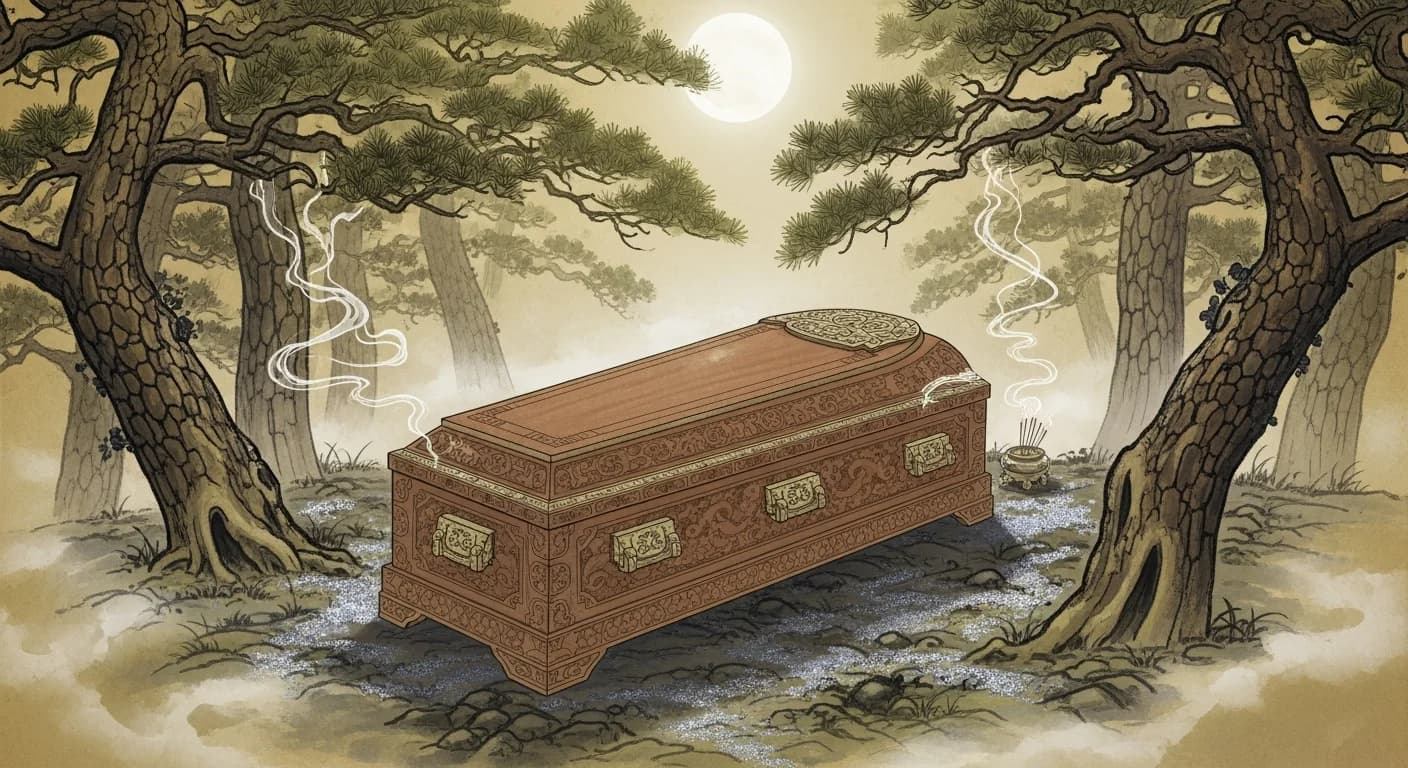
Carrying or shouldering a coffin in a dream indicates that an ongoing project will be brought to a successful conclusion. A coffin containing only bones suggests that you or your work will gain media attention and public recognition. A coffin resting in the courtyard of your home predicts wealth arriving ahead of schedule — before a business matter even concludes.
When a Coffin Dream Is Inauspicious — Deception, Loss, and Warning
Dreaming of entering a coffin while still alive is the most important warning in this category. Placing yourself in the role of the deceased signals that you may be deceived by a fraudster, or make a critical self-inflicted error that derails an important plan. After this dream, exercise exceptional caution with contracts, investments, or proposals from people you don't know well.
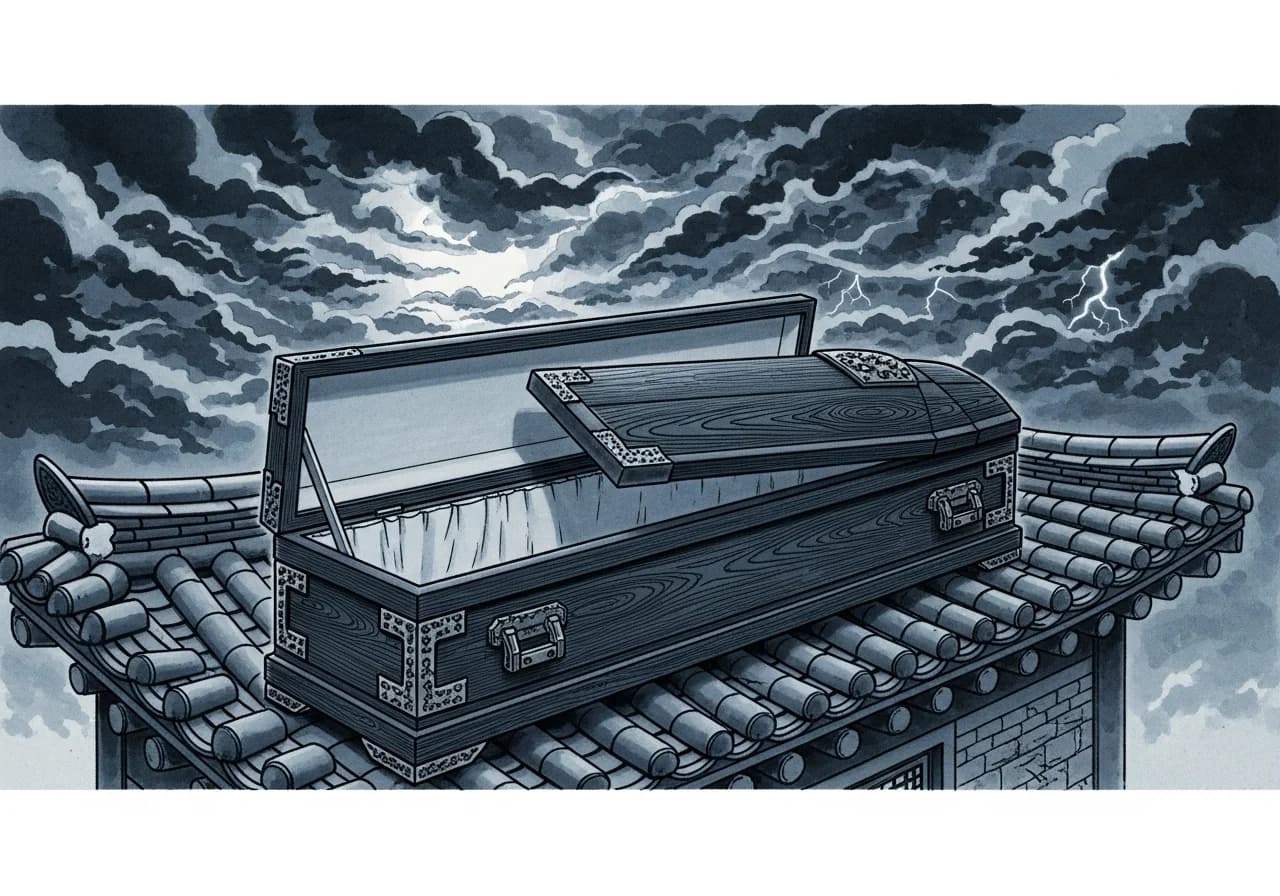
A coffin resting on a rooftop or roof ridge is interpreted as a strong omen of death or serious misfortune — a clear prompt to prioritize your health, safety, and awareness of potential hazards around you. A deceased person rising out of or climbing from a coffin warns of conflict, ruptures in important relationships, or business failure. An empty coffin predicts the loss of a valued possession or the cancellation of a significant agreement.
Neutral Coffin Dreams — Transition and Closure
Dreaming of placing a deceased person into a coffin or performing the coffin-closing ritual suggests that all matters will unfold according to your own will and intention. In a broader sense, this dream can mark the ending of one life chapter and the beginning of a new one — a natural transition rather than a loss.
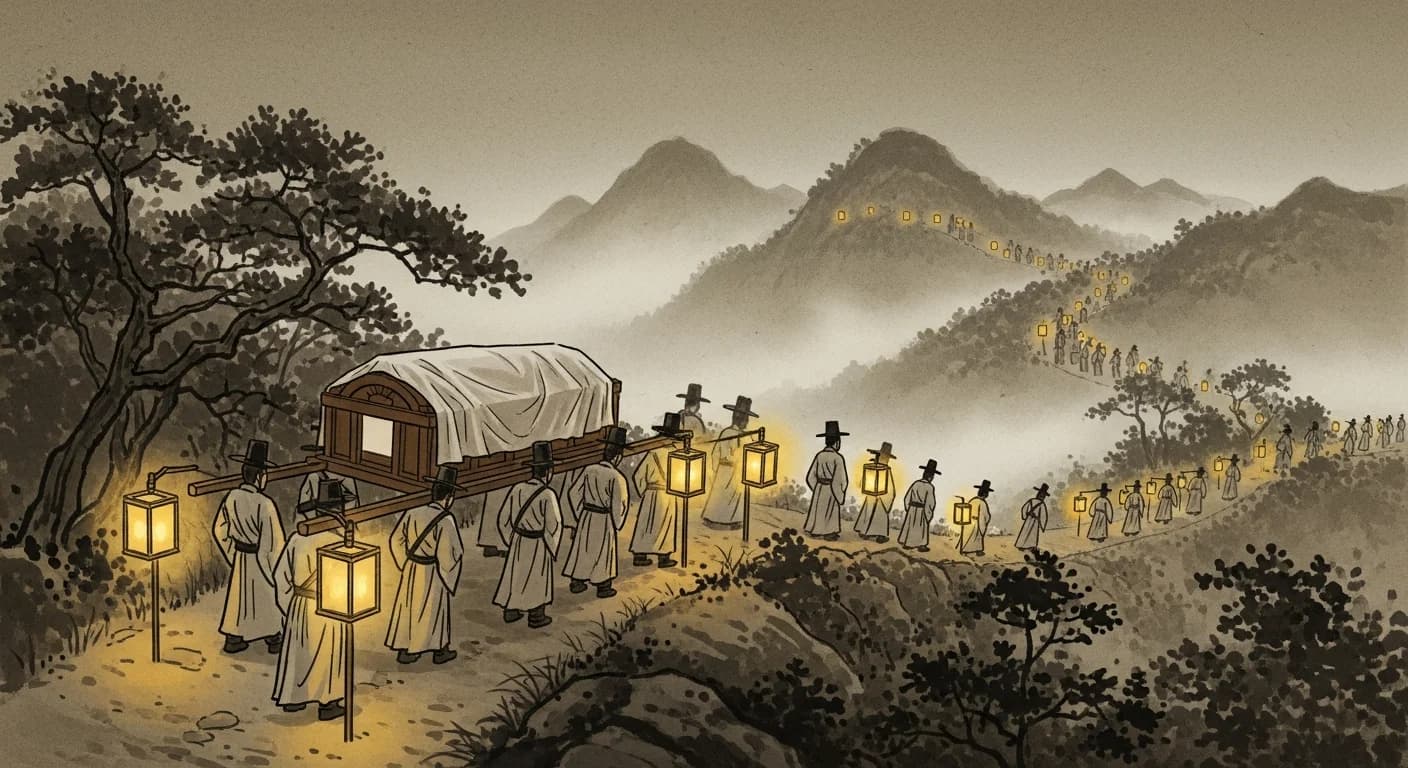
Dreaming of a funeral procession — a traditional Korean bier (상여) or hearse carrying a coffin away — is often read as an omen that financial leakage will stop and business fortune will improve significantly. It can also carry a psychological meaning: the mind processing a farewell to something or someone the dreamer is finally ready to release.
Dream Variations
Dreaming of a Coffin Entering Your Home
One of the most famous wealth and promotion omens in Korean dream interpretation. Employees can expect a promotion, students an acceptance letter, and job seekers a successful hire. Based on the yeongmong (reverse dream) principle, a death-associated object arriving inside the home represents the inflow of new fortune and positive energy.
Dreaming of Entering a Coffin While Alive
An inauspicious dream warning of deception or fraud resulting in significant loss. After this dream, be especially careful with contracts, investments, and proposals from unfamiliar people. Avoid making important decisions hastily without thorough due diligence.
Dreaming of Carrying or Shouldering a Coffin
An auspicious dream indicating that an ongoing task or project will be brought to a successful conclusion. The act of bearing a weight on your shoulders symbolizes responsibility fulfilled and a positive outcome achieved.
Dreaming of an Empty Coffin
An inauspicious omen predicting the loss of a valued possession or the cancellation of an important contract or agreement. This dream warns of emotional emptiness and the severing of financial or personal ties — a prompt to safeguard important relationships and assets.
Dreaming of a Coffin Lid Opening
An auspicious dream signaling that hidden matters or secret projects will be revealed to the world. All affairs will proceed smoothly, and something you have been quietly working toward will finally receive recognition and exposure.
Dreaming of a Coffin on a Rooftop
A strong inauspicious omen of death or serious misfortune. After this dream, pay careful attention to health check-ups, physical safety, and potential hazards in your immediate environment.
Dreaming of a Corpse Inside a Coffin
Interpretation depends on the details: an open coffin revealing a corpse is auspicious — all matters will be fulfilled. Putrid liquid flowing from the corpse signals major wealth acquisition. However, if the corpse moves or exits the coffin, it becomes a warning of conflict or relationship trouble ahead.
Dreaming of a Funeral Bier or Hearse
An auspicious dream predicting that financial leakage will stop and business fortune will improve significantly. It may also reflect a psychological readiness to let go of something from the past — a healthy farewell processed during sleep.
Dreaming of Building or Making a Coffin
An auspicious dream predicting unexpected wealth and a significant breakthrough in business fortune. The act of constructing something from scratch symbolizes new beginnings and prosperity that you are actively building.
Dreaming of a Coffin in the Courtyard
An auspicious dream predicting that wealth will arrive before a business matter is fully concluded — an omen of early financial windfall, advance payment, or exceptional profit in a deal or contract.
Cultural Context
In Korean traditional dream interpretation, the coffin (관/棺) carries a complex dual symbolism that extends far beyond a simple symbol of death. The crucial concept is yeongmong (역몽) — the deeply held folk belief that ominous-looking dream imagery often foretells positive real-world outcomes. The classic example is a coffin entering the home as a predictor of promotion and wealth.
During the Joseon dynasty, the funeral rite (상례, sangnye) was among the most solemn Confucian ceremonies, governed by detailed ritual protocols. The coffin was regarded as the sacred final resting place of the deceased and the gateway to the afterlife. Traditional Korean coffins were lined with a chilseongpan (칠성판) — a wooden board with seven holes carved in the pattern of the Big Dipper constellation — invoking celestial energy to guide the soul's safe passage from this world.
In Korean shamanism (무속신앙), death is not a terminus but a transition within a cyclical universe. This cosmological worldview naturally gave rise to folk interpretations of coffin dreams as signals of life transitions, endings that enable new beginnings, and the renewal of fortune. The coffin represents a threshold, not a wall — a door between what was and what will be.
Western Psychological Perspectives
Western Psychological Perspectives on Coffin Dreams
From a Freudian psychoanalytic perspective, dreaming of a coffin symbolizes the burial of repressed impulses or emotionally unbearable conflicts that the conscious mind has sealed away. The coffin represents a forbidden desire or a painful relationship that the psyche has 'killed off' and hidden from awareness. Freud viewed death imagery in dreams as frequently reflecting the tension between Eros (the life instinct) and Thanatos (the death drive), and a coffin dream may express the dreamer's unconscious wish to escape an overwhelming situation or bring a painful chapter of life to a definitive end.
Jungian analytical psychology offers a more transformative reading. The coffin symbolizes the mortificatio — the stage of psychological death within the individuation process where outdated ego structures must dissolve for a more integrated self to emerge. A coffin dream may signal that the dreamer is confronting their shadow: the unconscious, rejected aspects of the personality that must be integrated for genuine psychological wholeness. Jung viewed death imagery not as destruction but as transformation, recognizing the universal archetype of death-and-rebirth present in the collective unconscious. In this framework, the coffin is the threshold between who we were and who we are becoming — a reading that resonates strikingly with Korean folk tradition's interpretation of coffin dreams as auspicious new beginnings.
Modern cognitive and neuroscientific approaches tend to frame coffin dreams as the mind's response to existential stress from major life transitions — career changes, relationship endings, bereavement, or retirement. Research shows that people undergoing significant life upheavals dream more frequently of coffins and funeral imagery. This aligns with the threat simulation theory of dreaming, which proposes that the brain rehearses and emotionally processes difficult material during sleep. A coffin dream, in this view, is the mind safely working through feelings of loss, finality, and closure that are difficult to confront directly while awake.
What is remarkable is that despite their surface differences, Korean folk interpretation and Western psychological theory converge on the same essential insight: coffin dreams are not mere fear responses. They are meaningful signals of transition — the psyche's way of marking an ending that makes room for a new beginning.
Frequently Asked Questions
Coffin dreams are one of the most vivid examples of the yeongmong paradox in Korean folk tradition — where the most death-adjacent imagery often carries the most life-affirming omens. In the majority of scenarios, a coffin in a dream signals incoming wealth, professional advancement, or the start of a new chapter. The key exceptions are dreaming of entering the coffin yourself, or finding one on a rooftop — both of which carry genuine warnings. Pay close attention to the specific details and overall emotional tone of the dream; that context is what separates a powerful wealth omen from a prompt to proceed with caution.