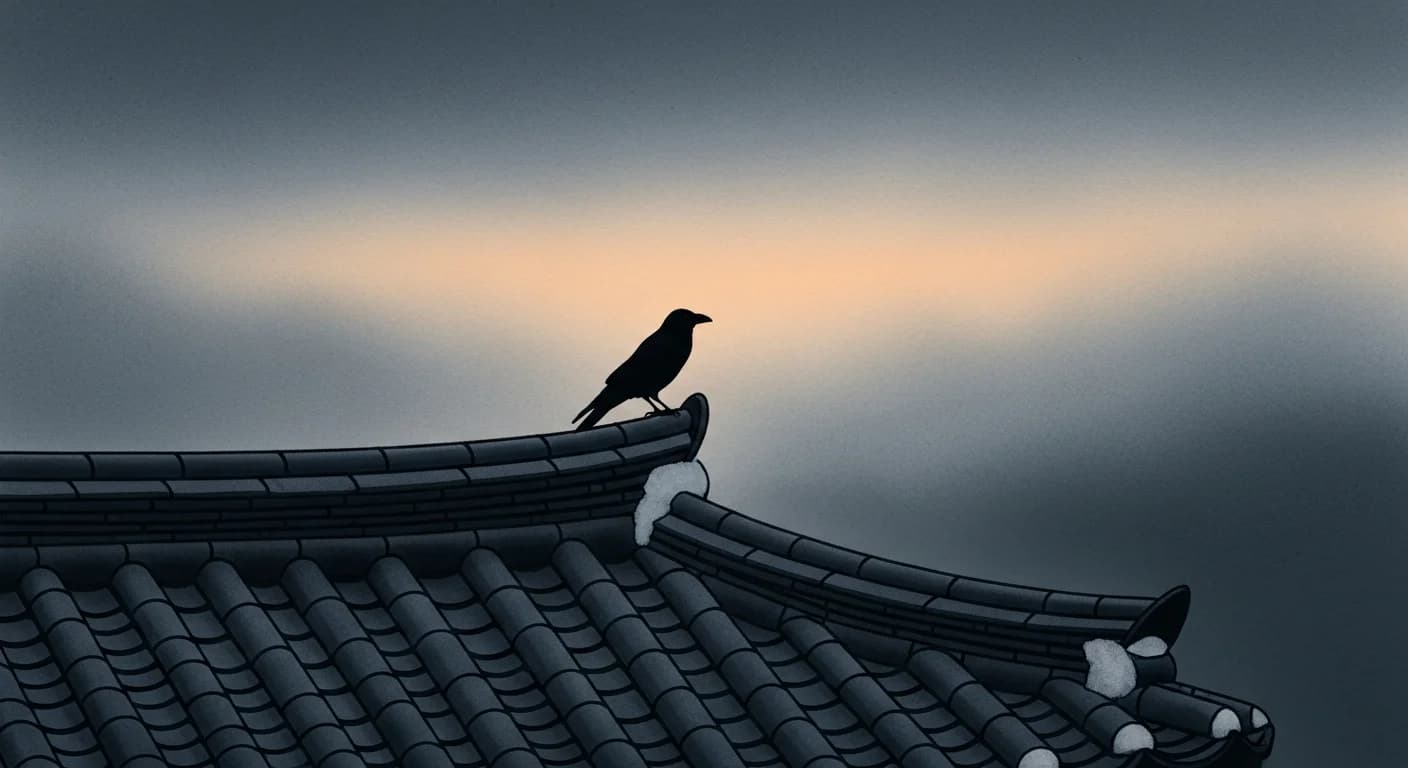
Crow Dream Meaning — Warning, Reversal, and the Dual Symbolism of Korea's Black Bird
If a crow visited your dream last night, what it was doing matters far more than the fact that it appeared. In Korean folk tradition, the crow is the quintessential harbinger of misfortune — its association with death and household calamity runs deep. Yet Korean dream interpretation has a fascinating twist: the very same bird that warns of disaster can become a lucky omen the moment you catch it, kill it, or see it in white. The crow's meaning is not fixed — it shifts with every detail of the scene.
When a Crow Dream Is a Warning — Inauspicious Interpretations

In Korean dream tradition (해몽), several crow scenarios carry strong inauspicious meanings that dreamers should take seriously.
A crow cawing loudly on the rooftop is the most classic bad omen. The roof symbolizes a household's protective shield in Korean folk belief, and a threatening bird perched on top signals that this protection is compromised. A family member may face illness, an accident, sudden financial trouble, or another form of misfortune. The shriller and louder the cry in the dream, the more urgent the warning is considered.
A crow flying into your home warns of betrayal from someone you trust, financial loss, or a hidden domestic conflict about to break into the open. The home represents the inner order of self and family — an intrusive dark bird disturbs that order.
A flock of crows circling overhead is not a personal omen but a collective one — it signals family discord, a business-level crisis, or the loss of allies and supporters. If you dreamed of being chased by a crow, the image may reflect anxiety about legal consequences or a responsibility you have been avoiding. The crow, in this case, embodies an external force demanding accountability.
When a Crow Dream Is Lucky — The Auspicious Reversal
Korean dream interpretation embraces the paradox at the heart of crow symbolism: the bird of ill omen can flip into a carrier of good fortune under the right circumstances.
Catching a crow with your bare hands is a clear good-luck dream. It represents averting danger through sharp instinct, preventing a financial loss before it materializes, or gaining the upper hand in a business negotiation or legal dispute. The dream rewards proactive boldness.
Seeing a dead crow or killing one in the dream is equally auspicious — perhaps the most powerful lucky variant of the crow dream. Long-standing worries dissolve, obstacles that have blocked you fall away, and a genuine new beginning becomes possible. 'The death of the death bird' is read as the end of misfortune and the start of renewal.
Eating crow meat is an unambiguous financial luck signal — increased income, investment gains, or an unexpected windfall. In Korean dream logic, consuming an animal absorbs its energy into yourself. To eat a crow is to internalize its sharp survival instinct and cunning.
A white crow is the rarest and most auspicious crow dream of all. The impossible color — a bird of darkness gone pure white — signals extraordinary luck in academics, career, or relationships. A helpful patron figure may enter your life, or you may achieve results that exceed all expectations.
Wealth and Financial Fortune — What Crow Dreams Signal for Money
Crow dreams carry clear signals for financial matters, and the direction depends entirely on what happens in the dream. Crows that caw, enter the home, or steal objects warn of financial loss, scams, or investment failures. Pay special attention if a crow was carrying something away — that detail often points directly to wealth draining from your life.
The auspicious variants — catching, killing, or eating a crow — all point toward financial recovery and growth. Blocked funds may loosen, delayed returns may arrive, or an opportunity that seemed out of reach may suddenly become accessible. These dreams often appear at genuine turning points in the dreamer's financial situation.
Health Signals — Reading the Crow's Message for Your Body and Family
Beyond fortune and misfortune, crow dreams in Korean tradition carry specific health messages. A crow on the rooftop or entering the home is traditionally read as a warning to check on a family member's health — not just an abstract bad omen, but a specific prompt to schedule that overdue check-up or look in on an elderly relative.
By contrast, a dead crow dream can signal the opposite — improvement in a chronic condition, the resolution of a long illness, or the body moving into a healing phase. The obstacle that has been weighing on physical wellbeing may be clearing.
Dream Variations
Crow Cawing Dream Meaning
A loudly cawing crow warns of financial setbacks, disruption to ongoing plans, or becoming the subject of gossip and false rumors. The key detail is distance: a crow cawing far away carries lower urgency, while one cawing right next to your ear demands immediate attention. Avoid rushing into major contracts or investments in the wake of this dream.
Crow on Roof Dream Meaning
One of the most iconic inauspicious dream images in Korean tradition — a crow perched on the rooftop and cawing forecasts household misfortune. The roof symbolizes the family's protective boundary, and its breach by a dark omen bird signals trouble ahead for a family member: illness, accident, or sudden hardship. Use this dream as a reminder to check on loved ones.
Flock of Crows Dream Meaning
Multiple crows in a group signal collective rather than individual misfortune — family strife, organizational crisis, or the withdrawal of important supporters. However, the ending of the dream matters: if the flock eventually flies away into the distance, the crisis will be temporary and will resolve with less lasting damage than feared.
Dead Crow Dream Meaning
A dead crow in a dream is a lucky sign in Korean interpretation — the end of persistent worries, difficult relationships, or stubborn obstacles. Health recovery, improved relationships, and cleared professional pathways are all signaled. The paradox of 'a dead death-bird' is at the center of Korean crow symbolism: the removal of the omen source itself becomes the omen of renewal.
Catching a Crow Dream Meaning
Grabbing a crow with your hands is an active, bold action in the dream — and it reads as a lucky omen. It symbolizes successfully stopping a threat through instinct and decisiveness, preventing financial loss, or winning out in a competitive or adversarial situation. The dream affirms that proactive action will produce real results.
Crow Flying Toward You Dream Meaning
A crow diving directly at you warns of unexpected bad news, an unwelcome visitor, or a problem incoming from outside your current awareness. The important qualifier: if you stood your ground and faced the crow rather than running, it signals you have the inner resources to handle whatever is approaching.
Talking Crow Dream Meaning
A crow that speaks or tries to communicate is your subconscious sending an urgent signal — you are at a crossroads and may be overlooking something important. The dream urges you to slow down, seek advice from someone you trust, and resist the urge to decide quickly. The talking crow is wisdom disguised as a warning.
White Crow Dream Meaning
A white crow is the rarest and most powerfully auspicious crow dream variant. The impossible coloring — dark made light — signals extraordinary good fortune arriving in an unexpected form. A helpful mentor or patron may appear, or outstanding results in exams, interviews, or major life milestones may be on the horizon. This dream is a genuine lucky sign.
Crow Landing on Your Shoulder Dream Meaning
A crow settling on your shoulder or body warns that someone else's burden or responsibility is about to be transferred to you. Be cautious about unconditionally agreeing to favors, co-signing obligations, or taking on extra work without clear boundaries. This dream is a reminder to protect your own time and energy.
Eating Crow Meat Dream Meaning
Eating crow meat is unambiguously good news for finances. In Korean dream logic, eating an animal absorbs its essence — and the crow's sharp survival instinct becomes your advantage. Expect improved income, better-than-expected investment returns, or a financial breakthrough that was not on your radar.
Cultural Context
The crow occupies a uniquely layered symbolic position in Korean culture — one that everyday folk belief and ancient royal mythology handle in almost completely opposite ways.
In traditional folk belief, the crow has long been the quintessential bird of ill omen. Its habit of gathering near burial grounds and consuming funeral offerings cemented its association with death, the boundary between the living and the dead, and household misfortune. The proverb 'where crows cry, death follows' (까마귀 우는 곳에는 죽음이 온다) captures this deep-seated cultural dread precisely.
Yet in Korean royal mythology and ancient cosmology, the crow was sacred. Goguryeo tomb murals — at Kakjeochong, Ssangyeongchong, and Cheonwangjishinchong — depict the Samjogo (三足烏), a three-legged crow living inside the solar disc. This divine bird was the incarnation of the sun, a sacred messenger bridging heaven and the human world, and a symbol of royal legitimacy. The Silla legend of Yeon-o-rang and Se-o-nyeo similarly features crows as symbols of light and life-force.
This duality — daily omen of disaster vs. mythological avatar of the sun — gives Korean crow symbolism a depth that purely Western interpretations miss. The shared imagery extends across East Asia: in China the crow symbolizes filial piety, and in Japan the Yatagarasu (八咫烏), a three-legged divine crow, guides the sun and appears in the founding mythology of the imperial lineage. In all three traditions, the crow connects the cosmic and the earthly in ways that transcend simple good-or-bad categorization.
Western Psychological Perspectives
Western psychological traditions offer a rich counterpoint to Korean folk interpretation — and in many ways, they arrive at surprisingly similar conclusions through different paths.
From a Freudian perspective, the crow in a dream represents the repressed death drive (Thanatos) and the guilty conscience. Its black coloring, association with death, and uninvited intrusion into the dream space signal that buried fears, guilt, or anxieties about punishment are breaking through into conscious awareness. Being threatened or chased by a crow may reflect the ego's confrontation with suppressed aggression or forbidden desires. Freud would ask: what specifically about the crow frightened you, and what in your waking life does that fear map onto?
Jungian psychology reads the crow as a classic Shadow archetype — the dark, unacknowledged aspects of the self including anger, envy, fear, and grief. The crow's black plumage and death associations make it a natural container for everything the conscious mind prefers not to look at. Here is where the Korean and Jungian traditions converge most strikingly: catching or killing the crow in a dream — which Korean tradition reads as a lucky sign — corresponds in Jungian terms to successfully integrating shadow material, a milestone in the individuation process. Both traditions agree that confronting the crow is more powerful than fleeing it.
Modern cognitive neuroscience frames crow dreams as the brain's threat-processing response to stress, anticipated change, or unresolved anxiety. The crow's remarkable intelligence is worth noting in this context: crows are among the few non-primate animals capable of tool use, planning, and recognizing individual human faces. When a crow communicates in a dream rather than attacking, modern psychology reads this as the dreamer's own problem-solving capacity awakening to a challenge they have not yet consciously acknowledged.
Cross-culturally, the contrast with Western traditions is dramatic. Norse mythology's Odin dispatches his ravens Huginn (Thought) and Muninn (Memory) across the world each day to gather intelligence and report back — the crow as the embodiment of wisdom and omniscience. The Celtic Morrigan shapeshifts into a crow to prophecy fate. Native American traditions honor the crow as a trickster-creator, a figure of transformation and hidden knowledge. Where Korean folk tradition sees a messenger of doom, the Western mythological tradition often sees a messenger of divine insight. The same bird; radically different cultural lenses — a reminder that dream interpretation is always as much about culture as it is about the unconscious.
Frequently Asked Questions
The crow dream is one of Korean dream interpretation's most nuanced — a bird that warns and blesses in almost the same breath. The single most important detail is what the crow was doing: cawing on your roof and entering your home carry genuine warnings worth heeding, while catching, killing, or seeing a white crow signal that a tide is turning in your favor. Whatever type of crow dream you had, notice the emotion it left with you. A dream that woke you with dread calls for careful attention to family health and financial caution. A dream where you held the crow in your hands may mean the obstacle you feared is already losing its power.
Related Dreams
Magpie Dream Meaning: Korea's Beloved Herald of Good News
Owl Dream Meaning — Between Wealth Omen and Warning in Korean Tradition
Eagle Dream Meaning: What Korean Dream Tradition Says About the Sky's Ruler
Black Cat Dream Meaning — A Korean Dream Interpretation Guide

Dead Bird Dream Meaning — Warning Sign or Signal of Transformation?

Bird Flying Dream Meaning