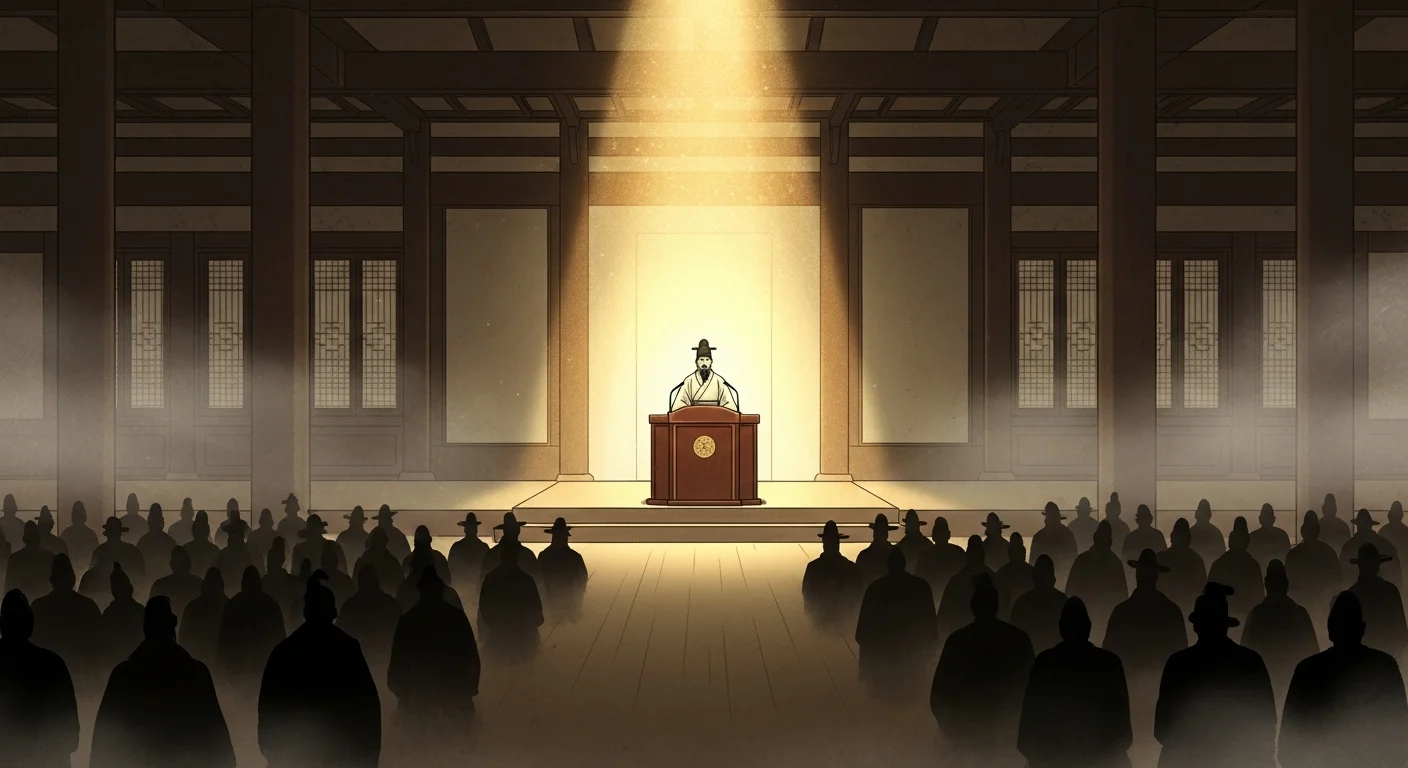
Giving a Speech Dream Meaning — The Voice That Shapes Destiny
Dreaming of giving a speech is not just a replay of everyday anxieties — it's one of the most symbolically charged dream experiences a person can have. Deliver your speech with confidence and hold that crowd spellbound, and you're looking at a powerful omen of recognition, influence, and doors opening in your waking life. In Korean culture, the art of public oratory (웅변, ungbyeon) has historically been a mark of intelligence and moral authority — so this dream taps deep cultural resonance. But here's the twist: if the words don't come, or the audience turns hostile, the meaning flips entirely. The tone of your dream speech is everything.
Giving a Confident, Well-Received Speech — Auspicious Omen

Dreaming of delivering a speech with total confidence — voice clear, words flowing, audience leaning in — is a strongly positive omen. It foretells that your ideas, proposals, or creative work will soon gain recognition and genuine acceptance from those around you. In a professional context, this dream often appears before a major project succeeds, before a promotion comes through, or before you are trusted with a leadership role. The more enthusiastic the audience's response — applause, a standing ovation, visible emotion — the greater the fortune being predicted. Think of it as your inner compass telling you: the path you're on is the right one. Keep going.
Freezing Up, Losing Your Voice, or Facing a Hostile Crowd — Cautionary Omen

Stuttering mid-speech, going completely blank, watching your notes scatter to the floor, or having an audience laugh and boo you — these are cautionary signals. This dream reflects deep anxiety about performance and self-expression: the fear of being found unprepared, inadequate, or dismissed. It frequently surfaces before high-stakes real-world events — a major presentation, a job interview, a difficult conversation. An audience that walks out or mocks you can symbolize fears of being misunderstood, rejected, or ignored by people whose opinions carry weight. The dream's message isn't doom — it's a directive. Prepare more thoroughly. Address your self-doubt before it becomes self-sabotage.
A Calm, Emotionally Flat Speech — Neutral Interpretation
If you dream of giving a speech without strong emotion attached — just standing at a podium, words coming out, nothing particularly good or bad happening — this is a neutral, inward-looking dream. Rather than predicting a specific event, it reflects a period of inner processing. Something important wants to be said, and you are formulating it. You may be on the verge of a decision, a difficult conversation, or a creative breakthrough that requires you to articulate your thoughts clearly. Think of this dream as the rehearsal space before the real performance.
Dream Variations
Dream of Commanding an Audience with Confidence
Holding a crowd rapt with effortless confidence signals growing influence in your professional or social sphere. Leadership opportunities are approaching, and important proposals you put forward will meet with approval. This is a dream that encourages bold action — the time to step up is now.
Dream of Going Blank or Freezing Mid-Speech
Freezing or stuttering in a dream mirrors real anxiety about being unable to express yourself clearly under pressure. It often appears before high-stakes presentations, interviews, or important conversations. Rather than a bad prediction, treat it as a signal to prepare more thoroughly and identify the root source of your self-doubt.
Dream of Forgetting Your Speech or Losing Your Notes
Losing your notes or blanking on what you prepared symbolizes fear of being caught unprepared or exposed as inadequate. It often emerges when real-life deadlines are looming and you feel you haven't done enough groundwork. Take it as a signal to review your preparation and shore up any gaps — you have more time than the dream suggests.
Dream of the Audience Laughing or Jeering at You
An audience that mocks or jeers you during a speech represents fear of ridicule and rejection from those whose opinions matter to you. This dream often appears during periods when you feel your ideas aren't being taken seriously. It calls on you to build inner confidence and resist allowing others' potential reactions to silence your voice.
Dream of Delivering a Speech to a Vast Crowd
Speaking to thousands in a dream reflects a strong inner drive toward large-scale impact and influence. You may feel ready — or aspire — to take on a more prominent role, champion a cause, or reach a wider audience with your ideas. This dream often precedes an opportunity to step into a more influential position than you currently hold.
Dream of Speaking to an Empty Auditorium
Delivering a speech to rows of empty seats represents a profound sense of being unheard or ignored in waking life. Your words or efforts may be going unacknowledged. This dream calls attention to a breakdown in communication — whether in relationships, at work, or in your broader social circle — and urges you to seek genuine connection.
Dream of Making a Political Speech
A political speech dream symbolizes ambitions for authority, public influence, and the desire to champion a cause or set of values. You may feel called to a leadership role, wish to effect change at an organizational or community level, or crave recognition for your capabilities. Such dreams often herald an opening for expanded influence in real life.
Dream of Losing Your Voice Just as You Begin to Speak
Losing your voice during a speech is one of the most powerful dream symbols of suppressed self-expression. In waking life, you may be holding back important thoughts — perhaps from an authority figure, a partner, or even from yourself. This dream is an invitation to examine what you are afraid to say and to find a safe, appropriate way to say it.
Dream of a School Presentation or Class Speech
School presentation dreams — even in adulthood — reflect anxiety about being judged, evaluated, or tested. The school setting is where performance is measured and results are graded. This dream is common during periods when you feel scrutinized at work or in relationships, when you sense that others are forming judgments about your competence or worth.
Cultural Context
In Korean culture, public oratory — 웅변 (ungbyeon), literally 'powerful speech' — carries a weight that goes far beyond Western conceptions of public speaking as a professional skill.
During the 1970s, amid the Cold War climate and government-driven nationalism, oratory academies (웅변학원) spread across Korea with remarkable speed. They were so popular that taekwondo schools began offering speech training as a complementary service. The style of oratory promoted was passionate and emotionally charged — designed to 'make the blood boil' and move the audience to conviction. State-encouraged competitions created a generation for whom eloquent speech was inseparable from patriotism and moral seriousness.
This tradition produced celebrated orators at the highest levels of Korean public life. President Roh Moo-hyun is widely regarded as the most persuasive presidential speaker in Korean history, while President Kim Dae-jung famously delivered a five-hour-nineteen-minute parliamentary filibuster entirely from memory — a feat still cited as a standard of oratorical dedication.
For Koreans, then, eloquent public speaking is not merely a communication tool — it is an expression of intelligence, moral authority, and commitment to community. Dreaming of giving a powerful speech taps into this deep cultural reservoir: the aspiration to stand before one's community, be seen, be heard, and stand for something meaningful.
Western Psychological Perspectives
Western psychology offers several compelling frameworks for understanding why we dream of giving speeches — and why these dreams so often feel more vivid and emotionally intense than ordinary dreams.
From a Freudian perspective, speech dreams represent classic wish fulfillment. When waking life forces you to silence yourself before an authority figure — a boss, a parent, a social norm — the repressed desire to assert yourself finds an outlet in the dream. The dream delivers what reality denies: a platform and a voice. In this frame, losing your voice during a speech reflects the censor — the ego's defensive mechanism — blocking full self-expression even within the dream space itself.
Jungian analysis opens a different layer. For Jung, the speech dream engages the Persona archetype — the public mask we wear before the world. Giving a speech is, literally, the act of presenting your persona to a collective audience. A well-received dream speech may signal that your social self and deeper inner Self are in productive alignment. A humiliating speech dream, by contrast, often signals that the persona you wear publicly is out of sync with who you truly are — a call toward greater authenticity.
Modern cognitive neuroscience frames these dreams more pragmatically. Glossophobia — fear of public speaking — is consistently rated one of the most common human fears worldwide. Research suggests that anxiety-laden performance dreams serve as the brain's rehearsal mechanism: running through threatening scenarios to reduce their emotional charge and better prepare the individual for real-world performance. In this sense, a nightmare about freezing at the podium may actually improve your next real presentation.
Cross-culturally, the core emotional dynamic is universal — the longing to have one's voice heard and the terror of being dismissed — even if the cultural inflection differs. Western contexts frame public speaking as individual self-assertion; East Asian contexts, including Korean, tie it more closely to communal responsibility and collective leadership. Both anxieties, different cultural packaging.
Frequently Asked Questions
A speech dream is one of the most psychologically revealing dream experiences we have — a direct window into how we relate to our own voice and its power in the world. If you soared in your dream, take it as a green light: your confidence is well-founded, and recognition may be closer than you think. If you stumbled, don't interpret it as fate — interpret it as feedback. The dream is pointing you toward preparation, self-awareness, and the courage to say what needs to be said. In the end, both versions of this dream ask the same question: What is it that you've been waiting to tell the world?
Related Dreams

Performing on Stage Dream Meaning — Applause, Anxiety, and What Korean Dream Tradition Says

Singing Dream Meaning — Complete Korean Dream Interpretation Guide

Shouting Dream Meaning — What Korean Dream Tradition Tells Us About Yelling in Your Sleep

Job Interview Dream Meaning — What Korean Dream Tradition Really Says